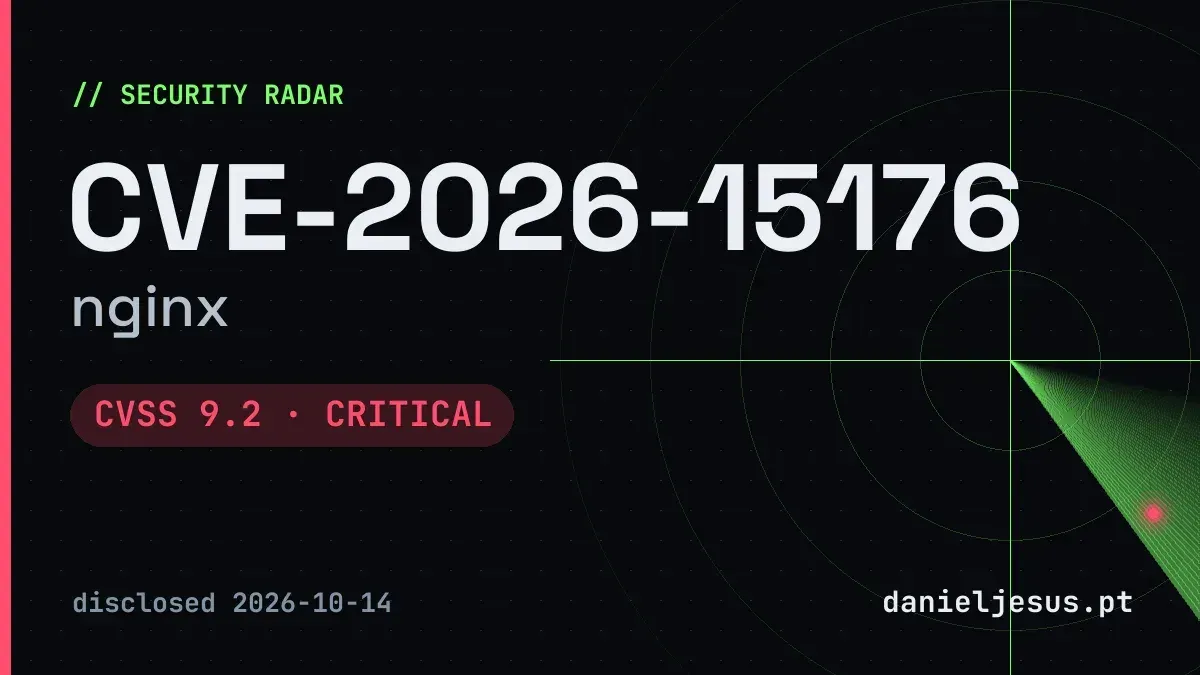
CVE-2026-15176: Critical Vulnerability in NGINX
A critical vulnerability in NGINX may allow denial-of-service attacks and code execution.
// on this page (8)
Introduction
The CVE-2026-15176 vulnerability affects NGINX Plus and NGINX Open Source, allowing unauthenticated attackers to cause a denial-of-service (DoS) state or, in some cases, execute malicious code.
What happened?
This vulnerability arises when a location is configured using the alias directive in conjunction with the rewrite directive and a set or return directive referencing the $request_filename variable. Additionally, the same situation can occur when the $request_filename variable is used in an access log format directive.
How the vulnerability works
The vulnerability can be exploited by sending crafted HTTP requests. This may lead to a heap buffer overflow in the NGINX worker process, resulting in a service restart. On systems where Address Space Layout Randomization (ASLR) is disabled or where the attacker can bypass ASLR, there is a possibility of code execution.
What is the real impact?
The impact of this vulnerability can be significant, as it allows remote attackers to cause a denial-of-service on the NGINX system or, under specific circumstances, trigger code execution. It is important to note that this vulnerability does not expose the control plane; it is solely a data plane issue.
Which versions are affected?
- dos ≥ 4.5.0 ≤ 4.7.0
- dos ≥ 4.8.0 ≤ 4.10.0
- nginx gateway fabric ≥ 2.1.0 ≤ 2.7.2
- nginx ingress controller ≥ 5.6.0 ≤ 5.6.3
- nginx instance manager ≥ 2.18.0 < 2.24.0
- nginx open source ≥ 0.1.29 < 1.30.6
- nginx open source ≥ 1.31.0 < 1.31.7
- nginx plus ≥ 37.0.0 < 37.0.5.1
- nginx plus ≥ 37.1.0 < 37.1.0.1
- nginx plus r33
- nginx plus r34
- nginx plus r35
How to fix
- Check your NGINX version and identify if it is among the affected ones.
- Consider upgrading to a patched version as soon as it becomes available. The fixed version should be confirmed in the vendor's advisory.
- Review your NGINX configuration to avoid using the alias directive in conjunction with rewrite and the $request_filename variable.
- Monitor NGINX access and error logs for potential exploitation attempts.
Mitigation while you update
While it is not possible to apply an update, it is recommended to review NGINX configurations and avoid using directives that may lead to the exploitation of the vulnerability. Additionally, implement monitoring measures to detect anomalous behavior.
Conclusion
The CVE-2026-15176 vulnerability poses a significant risk to NGINX systems. It is crucial for system administrators and store owners to take proactive measures to mitigate the risks associated with this flaw.
// Fontes
- NVD — CVE-2026-15176 nvd.nist.gov ↗
- CVE.org — CVE-2026-15176 cve.org ↗
- my.f5.com (vendor advisory) my.f5.com ↗