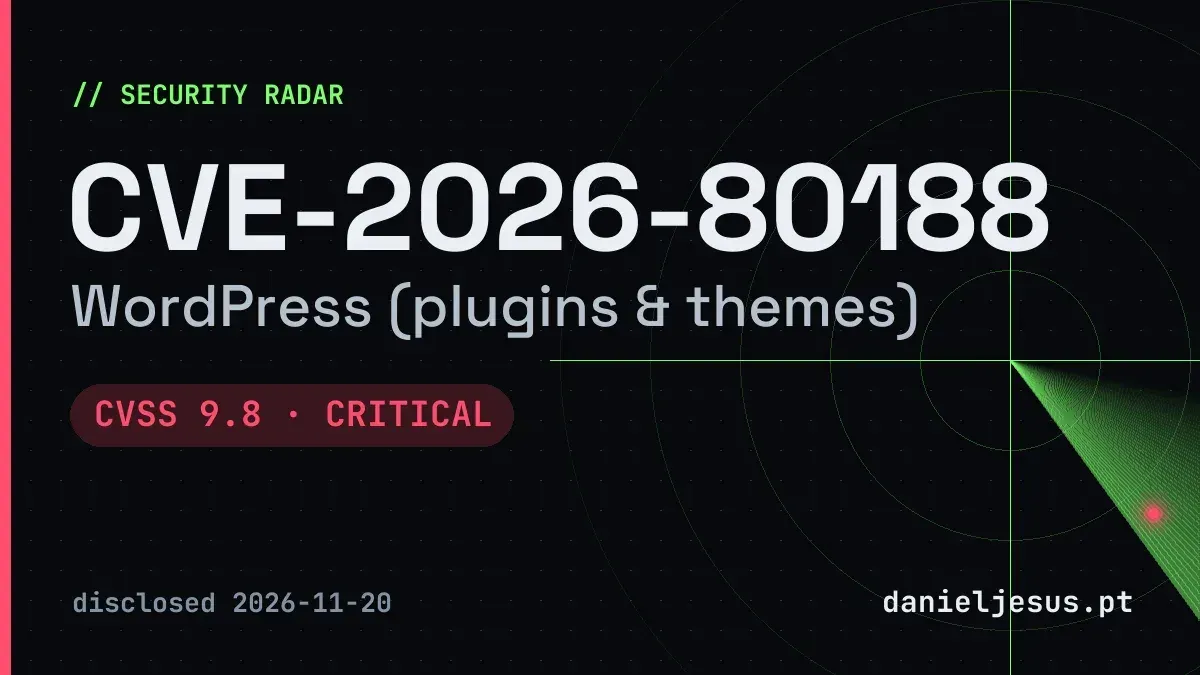
CVE-2026-80188: Authentication Bypass Vulnerability in BuddyBoss Addons Plugin
The vulnerability in the BuddyBoss Addons plugin allows unauthenticated attackers to take over accounts.
// on this page (8)
Introduction
The CVE-2026-80188 vulnerability affects the BuddyBoss Addons plugin for WordPress, allowing unauthenticated attackers to take over user accounts, including administrator accounts.
What happened?
The BuddyBoss Addons plugin is vulnerable to an authentication bypass due to how the Social Login REST endpoint handles identity tokens from Apple and Facebook. This vulnerability allows an attacker to associate a provider identifier controlled by them with an existing user account using the user's email as a claim.
How does the vulnerability work?
The vulnerability occurs because the REST endpoint trusts unverified identity tokens. An attacker who knows a user's email address can use this to associate their own provider identity with the user's account. This allows the attacker to authenticate as the user, potentially compromising the account and accessing sensitive information.
What is the real impact?
The impact of this vulnerability is critical, as it allows unauthenticated attackers to access user accounts, including administrators, leading to potential security compromises on WordPress sites. Successful exploitation can result in unauthorized access to sensitive data and full control over the user account.
Which versions are affected?
- Up to and including version 1.2.1 of BuddyBoss Addons.
How to fix
- Update the BuddyBoss Addons plugin to the latest version as soon as it becomes available.
- Ensure the BuddyBoss Platform plugin is installed and active.
- Disable the Social Login module if it is not necessary.
- Review your WordPress site's authentication and security settings.
Mitigation while waiting for updates
While waiting for the update, consider disabling the Social Login module and monitoring user accounts for suspicious activity. Additionally, implement extra security measures such as two-factor authentication.
Conclusion
The CVE-2026-80188 vulnerability in the BuddyBoss Addons plugin poses a significant risk to the security of WordPress sites. It is crucial for administrators to update the plugin as soon as a fix is available and to implement appropriate mitigation measures.
// Fontes
- NVD — CVE-2026-80188 nvd.nist.gov ↗
- CVE.org — CVE-2026-80188 cve.org ↗
- buddyboss.com buddyboss.com ↗
- Wordfence wordfence.com ↗