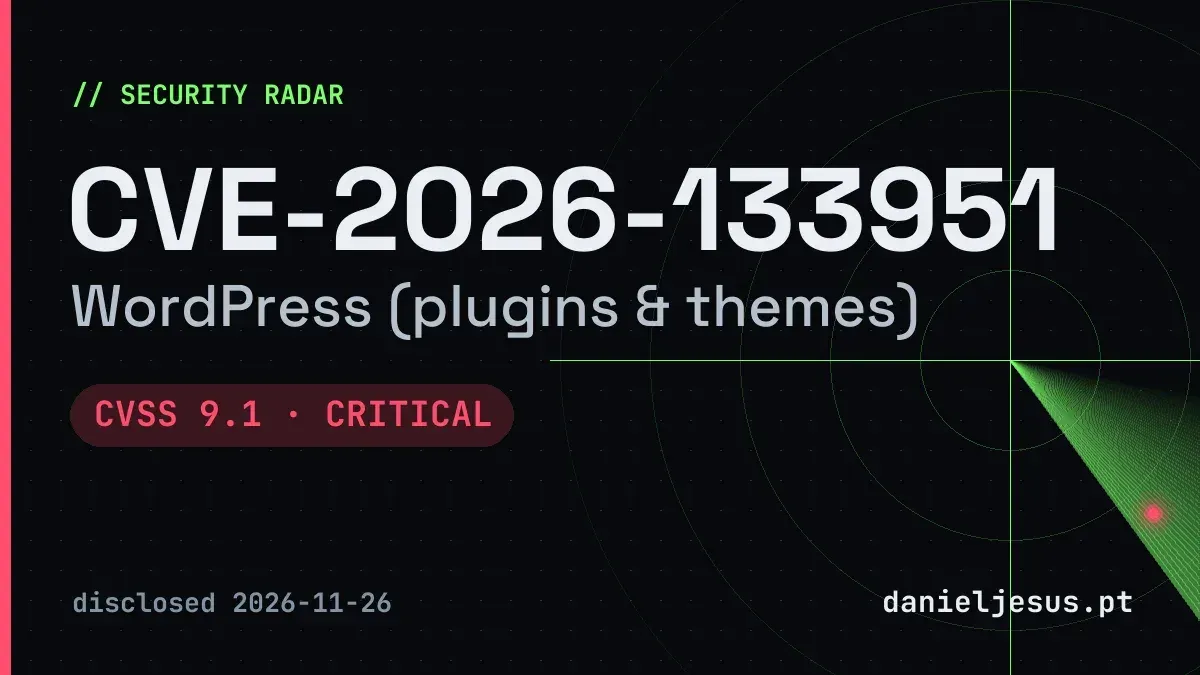
CVE-2026-133951 - Privilege Escalation Vulnerability in Simple Membership Plugin for WordPress
The Simple Membership plugin for WordPress has a critical vulnerability that allows privilege escalation.
// on this page (8)
Introduction
The Simple Membership plugin for WordPress has a critical vulnerability that allows privilege escalation. This flaw can be exploited by unauthenticated attackers to gain access to membership levels that should not be available.
What happened?
The vulnerability arises from how the site-wide signing secret is generated during the plugin's installation. The method used, based on PHP's `uniqid` function, creates a key that can be easily guessed through brute-force attacks. This, combined with how the plugin validates new user registrations, allows an attacker to create an account with elevated privileges.
How does the vulnerability work?
The vulnerability occurs due to the generation of the `swpm_private_key_one` secret, which is derived from a timestamp. Through the WordPress REST API, an attacker can constrain the possible key space. The plugin uses a non-constant-time comparison for authorization checks, allowing an attacker to forge a valid membership level hash and register as a member with elevated privileges.
What is the real impact?
If exploited, this vulnerability can allow an unauthenticated attacker to create a user account with a high membership level, including the potential to gain access to administrative functions, except for the administrator role. This could compromise the security of the site and allow the attacker to perform unauthorized actions.
Which versions are affected?
- Up to 4.8.9
How to fix
- Update the Simple Membership plugin to the latest available version.
- Ensure that all keys and secrets generated during installation are secure and have not been compromised.
- Review user permissions and access levels to ensure no accounts have excessive privileges.
Mitigation while waiting to update
- Disable the Simple Membership plugin until a security update is available.
- Monitor user accounts for suspicious activity and revoke unauthorized access.
- Consider implementing additional security measures, such as two-factor authentication.
Conclusion
The CVE-2026-133951 vulnerability in the Simple Membership plugin for WordPress poses a significant risk to the security of sites using it. It is crucial for administrators to update the plugin and implement mitigation measures to protect their systems.
// Fontes
- NVD — CVE-2026-133951 nvd.nist.gov ↗
- CVE.org — CVE-2026-133951 cve.org ↗
- downloads.wordpress.org downloads.wordpress.org ↗
- plugins.trac.wordpress.org plugins.trac.wordpress.org ↗
- plugins.trac.wordpress.org plugins.trac.wordpress.org ↗
- plugins.trac.wordpress.org plugins.trac.wordpress.org ↗
- plugins.trac.wordpress.org plugins.trac.wordpress.org ↗
- Wordfence wordfence.com ↗