// case study — 2026
P1nkDi4m0nd
I developed P1nkDi4m0nd.com using the same modular core as FutPulse, adapted for a digital creator's website. The project includes automated Instagram, TikTok and YouTube updates, API integrations, caching systems, performance optimization, cybersecurity and infrastructure.
AutomationDesign & FrontendDevelopmentMaintenanceMicroservicesPerformance OptimizationSecuritySEOSystems Administration
 // client — Dotec →

// on this page (20)
Project: P1nkDi4m0nd.com — Digital creator website with automatically synchronized social media content
Development: Full Stack Development, modular architecture, shared application core, Instagram, TikTok and YouTube integrations, automated content synchronization, caching, technical SEO, performance optimization, infrastructure and cybersecurity.
Tech Stack: Custom application core, plugin-based architecture, web development, APIs, databases, JavaScript, HTML, CSS, caching systems, Cloudflare and automated synchronization services.
Following a content creator usually means switching between several platforms. Videos are published on YouTube, shorter content appears on TikTok, updates arrive through Instagram, and communities may also exist on Discord or other communication channels.
Each platform has its own interface, algorithms and way of presenting information. For followers, keeping up with everything can mean checking several different applications.
P1nkDi4m0nd.com was developed to bring this digital presence together in one place. It's the official website of Pink Diamond!, a creative project focused on digital content, animations and videos shared across social media.
I was responsible for developing the platform, using a technical approach that I find particularly interesting: the website shares the same application core I developed for FutPulse.pt.
Although the two projects serve completely different purposes, they share the same technological foundation. FutPulse uses dedicated plugins for football-related information, while P1nkDi4m0nd uses only the components required for its own functionality.
The main feature of this project is its automated integration with Instagram, TikTok and YouTube. Instead of requiring someone to update the website whenever a new video or post is published, I developed mechanisms that retrieve information from these platforms and update the website automatically.
The result is a digital home that follows the creator's activity, maintains its own identity and reduces the work involved in keeping everything up to date.
The Challenge — Building a Website That Updates Itself
One of the most common difficulties when maintaining a personal website is keeping its content current.
Creating a page with a photograph, a short description and a few social media buttons is relatively straightforward. The challenge begins when that page is supposed to display the latest publications.
Whenever a new video is released, someone would normally need to access the website administration, copy the URL, update the image and change the content being displayed.
With several social media platforms involved, that work quickly becomes repetitive.
For P1nkDi4m0nd, I wanted to avoid this dependence on manual updates.
The challenge was to build a platform capable of following content published on YouTube, TikTok and Instagram, using automated mechanisms to retrieve and update information.
This allows the website to reflect activity on the original social channels without requiring direct intervention in its administration.
The idea was simple: the creator should focus on creating content. The website should take care of keeping up with what's being published.
Sharing an Application Core with FutPulse.pt
One of the most important decisions was not to build an entirely separate application from scratch.
FutPulse.pt already had its own application architecture, with components responsible for website functionality, content organization, external service communication and other supporting features.
Rather than duplicating that development work, I reused the same core to build P1nkDi4m0nd.com.
This approach made it possible to take advantage of an existing technological foundation while creating a completely different experience.
The goal wasn't to turn a football portal into a social media website through a few superficial changes.
It was to reuse the shared application structure and adapt the project-specific components to a new purpose.
FutPulse needs to process competitions, results, clubs and player statistics. P1nkDi4m0nd needs to present videos, social media publications, creator information and links to external channels.
These are different requirements, but many underlying technical responsibilities can be shared.
The real value of code reuse is keeping what is common without forcing different projects to behave in exactly the same way.
Modular Architecture — Separating Features Through Plugins
The modular structure of the application core was particularly important in making this reuse possible.
At FutPulse, many football-specific features are developed through dedicated plugins.
These components handle functionality related to sports data, including results, competitions and other football information.
When building P1nkDi4m0nd, there was no reason to include those features in a website where they would never be used.
The architecture allowed me to maintain the application's foundation while working only with the components required by the new project.
This avoids unnecessary functional complexity and makes it easier for both projects to evolve independently.
A change to football result processing, for example, shouldn't require modifications to a creator's website.
Similarly, a new social media integration shouldn't have to become part of FutPulse's football-specific functionality.
Modular development helps keep these responsibilities organized, allowing each project to have its own identity and dedicated services.
For me, this is one of the most interesting aspects of software engineering: building reusable components that solve common problems while retaining the freedom to create very different applications.
YouTube Integration — New Videos Without Manual Updates
One of the main integrations in P1nkDi4m0nd involves YouTube.
Pink Diamond! publishes videos and animations, including Shorts, which form part of the creator's digital identity.
I wanted the website to follow this activity and display recent content without someone having to edit the page manually.
To achieve this, I developed integration and synchronization mechanisms using information made available by YouTube.
The process involves connecting content to the correct channel, identifying publications and preparing the information required for presentation.
Video titles, identifiers, publication dates and associated visual resources are examples of information that can be used, depending on what the platform makes available.
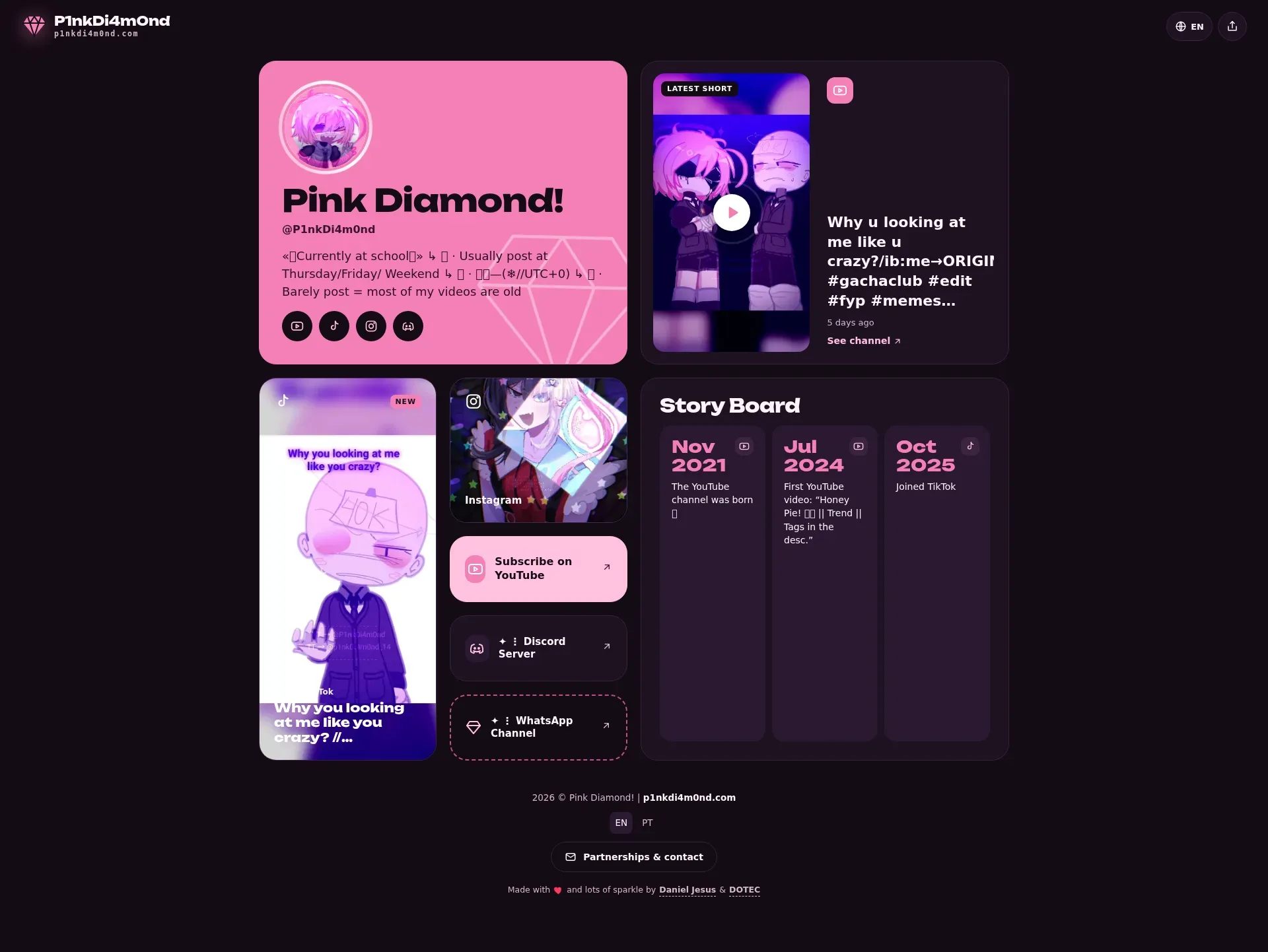
The homepage includes a section dedicated to the latest YouTube Short, providing access to the original content.
This keeps the website connected to the channel's actual activity instead of leaving an outdated video featured simply because nobody has updated it manually.
It's a relatively discreet feature from the visitor's perspective, but it involves external service communication, information processing and dynamic presentation.
TikTok Integration — Following the Latest Publications
TikTok is another platform integrated into the project.
As with YouTube, the aim was to allow P1nkDi4m0nd to follow the creator's publications automatically.
The website includes a section dedicated to the latest TikTok video, highlighting new content and allowing visitors to open the original publication.
Implementing this feature requires connecting the retrieved information to the correct profile and preparing the data used by the website.
One of the challenges with social media integration is that every platform has its own content structure and conditions for accessing information.
It isn't safe to assume that all platforms provide identical data or that their content can be processed in exactly the same way.
That's why I integrated TikTok according to the website's requirements, keeping the process of retrieving information separate from the way it's presented.
The goal was for a new publication on TikTok to be reflected on the website without requiring the same content to be published manually a second time.
Instagram — Connecting Another Part of the Creator's Digital Presence
Instagram is also part of the social media integrations developed for P1nkDi4m0nd.
It's a platform with a different experience from YouTube, bringing together photography, short videos, publications and different types of interaction.
During development, I worked on mechanisms that automatically retrieve and update information associated with the project's Instagram presence.
This helps keep the website connected to activity on the account without relying on manual changes whenever new content is available.
The information needs to be handled according to the characteristics of the available content and the platform's access requirements.
It's also important to avoid making the website's visual structure entirely dependent on how an external platform originally presents its data.
I prefer processing the information and presenting it according to the project's own design and organization.
That way, Instagram remains a content source while the website retains its identity and browsing experience.
Three Social Platforms, One Consistent Experience
One of the main technical decisions was to treat YouTube, TikTok and Instagram integrations as components of the same application.
Each service uses its own identifiers, formats and limitations. They don't necessarily provide the same fields or follow the same publication rules.
To present information from different sources within a consistent interface, data needs to be prepared before it reaches the frontend.
A publication might contain a video, image, title, description, date and additional metadata. However, not every element is necessarily available from every source.
The application needs to handle those differences without creating presentation errors.
My development work involved building the communication and processing mechanisms required by each source and integrating their results into the website's common structure.
It was also important to separate content retrieval from presentation, so that a change in an external service wouldn't require rebuilding the entire interface.
For visitors, the experience remains simple: discover the latest content and choose where they want to follow the creator.
Behind that experience is a collection of integrations and processing operations that need to work together.
Automated Synchronization — A Website That Follows New Content
One of the features that most clearly distinguishes P1nkDi4m0nd from a conventional personal website is automated content synchronization.
Instead of relying on a static page that needs constant editing, the platform uses synchronization mechanisms connected to the creator's social channels.
This allows website information to be refreshed using content published through the original platforms.
Developing a system like this requires consideration of several situations.
A publication might not immediately become available from the source being consulted. An external service may temporarily return an error. Certain information might be changed or become inaccessible.
Synchronization processes therefore need to handle these situations without unnecessarily affecting the rest of the website.
Another consideration is avoiding repetitive operations when the information being consulted hasn't changed.
Automated updates need to balance content freshness with efficient resource usage.
The goal is to reduce the work involved in maintaining the website, not to create another system that requires constant intervention to keep working.
APIs and External Services — Communication Between Applications
Integrating different social networks also demonstrates the importance of API integrations in modern software development.
An application doesn't need to produce every piece of information it displays. Sometimes the most appropriate approach is to communicate with specialized services and use the information they provide.
At P1nkDi4m0nd, I developed the mechanisms used to communicate with the external sources responsible for updating the portal.
These integrations require attention to response formats, content identification and handling situations where a service doesn't respond as expected.
Authorization mechanisms, access limitations and the policies associated with each platform also need to be respected.
An integration shouldn't depend entirely on receiving an ideal response. It needs to account for changes and temporary interruptions without unnecessarily affecting the application.
I brought this approach to P1nkDi4m0nd, drawing on the experience gained from developing other platforms involving multiple external services.
Caching Systems — Performance and Efficient API Usage
Caching systems are an important component of the architecture used by P1nkDi4m0nd.
There's little reason to request information from Instagram, TikTok and YouTube every single time someone opens the website, particularly when no new content has been published.
Caching helps reduce repetitive processing and unnecessary usage of external services.
The challenge is finding the right balance between efficiency and content freshness.
Information that rarely changes can generally be reused for longer periods. Identifying a new publication may require a different update policy.
This distinction influences how information is processed and made available to the frontend.
It's also important to consider how the application behaves when an external content source becomes temporarily unavailable.
A well-designed caching strategy can reduce dependence on immediate responses from third-party services, keeping previously retrieved information available when appropriate.
The goal was to deliver a fast, consistent experience without turning every website visit into an unnecessary sequence of requests to social media platforms.
Visual Design and Identity — A Website with Its Own Personality
P1nkDi4m0nd has a very different visual identity from FutPulse, despite sharing the same application core.
FutPulse is focused on sports information, statistics and structured data, while P1nkDi4m0nd is dedicated to a digital creator's identity and content.
I adapted the presentation to the visual world of Pink Diamond!, giving importance to the creator's name, identity, featured content and social channels.
The homepage has a direct structure, presenting the creator, recent publications and access to the platforms where new content is shared.
There is also a section called Story Board, showing some important moments in the project's development.
The YouTube channel began in November 2021, the first video identified on the website dates from July 2024, and the TikTok account was created in October 2025.
These details help tell the creator's story without making the website feel like an overly formal corporate page.
That was the design challenge: maintaining a well-organized and technically consistent experience while giving the website a personality appropriate to its content.
Portuguese and English — Reaching Different Audiences
The website is available in Portuguese and English, making it accessible to visitors from different countries.
Multilingual development involves more than replacing the visible text on a page.
Menus, system messages, forms, navigation elements and the identification of language versions all need attention.
At P1nkDi4m0nd, I worked on presenting the interface in both languages while maintaining a consistent visual identity and website structure.
Original content retrieved from social platforms can retain the language used by the creator, while the website's own interface is displayed in the language selected by the visitor.
This respects the original content while making navigation more natural.
Multilingual structure is also relevant to SEO because it helps distinguish pages intended for different language audiences.
Mobile Experience — Adding the Website to the Home Screen
P1nkDi4m0nd was developed with smartphones and tablets in mind.
A substantial amount of social media content is consumed on mobile devices, so it made sense to provide an experience designed for touch navigation.
The website includes a feature allowing visitors to add the portal to their device's home screen, giving them quick access through an icon in a way that feels similar to opening an app.
This provides an installable web experience without requiring users to search for the project in an application store.
The development also needed to consider video presentation, images, navigation controls and links to different social networks on smaller screens.
Although the technological foundation is shared with FutPulse, the visual experience was adapted to this website's specific requirements.
The goal was to offer a simple, responsive experience consistent with how people normally follow digital creators on their phones.
Contact and Partnerships — A Dedicated Communication Channel
Alongside social content, P1nkDi4m0nd includes a contact section for brands and partnerships.
This allows visitors to send messages directly through the website without having to use a particular social network.
The form collects contact information and the message the sender wants to submit.
Handling this information requires attention to input validation and protection against misuse.
It's also important that personal information is collected for a purpose that users can clearly understand.
The website includes a consent option relating to the storage of the information needed to respond to enquiries.
This provides the creator with a dedicated communication channel, complementing the existing social media, Discord and WhatsApp links.
It's a straightforward feature from a visitor's point of view, but it still needs to be securely integrated into the application.
Technical SEO — Building a Digital Identity Beyond Social Media
One of the advantages of developing a dedicated website for a content creator is the ability to establish an online presence independent of social platform profile pages.
At P1nkDi4m0nd, technical SEO is connected to content organization, the project's digital identity and how search engines interpret the website.
The creator's name, description, featured content and different language versions all contribute to this structure.
Clear page titles, correctly identified content and presentation suited to different devices are also important.
Automated updates add another consideration: displayed information can change without anyone manually editing the page.
The application needs to ensure that this dynamic behavior doesn't compromise the content structure or browsing experience.
Performance is also relevant, particularly when pages display references to videos and resources from external platforms.
My aim was to create an online presence that clearly identifies the project and allows visitors to discover its main channels and content from one place.
Infrastructure and Hosting — Managing the Portal's Services
Developing a portal with automated synchronization requires infrastructure capable of doing more than simply responding to web requests.
Alongside presenting pages, the application needs to communicate with external services, process information and make updated content available.
Managing the technical environment is part of the work involved in P1nkDi4m0nd, making use of the shared architecture developed for FutPulse.
Synchronization mechanisms, databases, caching and web services need to operate together.
It's also important to consider maintenance requirements and how integrations may evolve.
A change to an external platform may require adjustments to communication mechanisms, even when nothing changes in the website's visual design.
For that reason, I believe in maintaining clear separation between the application, integration services and components responsible for displaying content.
This organization helps make the system easier to maintain and develop.
Cybersecurity — Protecting the Application and Social Integrations
Cybersecurity is another important consideration within the project.
An application communicating with social platforms and retrieving information from external services needs to handle data and access mechanisms carefully.
Credentials and permissions used by integrations should not be publicly exposed, and received information needs to be validated before use.
The contact form introduces additional protection requirements because it accepts information submitted by visitors.
By reusing the core developed for FutPulse, I was able to work with a shared technological foundation while retaining security responsibilities associated with each component.
Application dependencies and changes to external services also need ongoing attention.
An integration that works today may require modifications later, especially when authentication mechanisms or data access conditions change.
For me, security should accompany the entire development lifecycle, including features that appear relatively simple.
Continuous Development — One Core, Multiple Independent Projects
One of the advantages of this architecture is the ability to continue developing the shared core while maintaining independent functionality for each project.
FutPulse and P1nkDi4m0nd demonstrate how the same technological foundation can support very different experiences.
The first focuses on football information and sports-related features. The second concentrates on a creator's digital identity and automated social media integration.
Shared responsibilities can benefit from improvements to the common architecture, while project-specific functionality remains separate.
This approach helps avoid duplicated work and makes use of knowledge gained through developing both applications.
It also provides a foundation for future projects that may require similar underlying services without needing to start from scratch every time.
The challenge is keeping that reuse organized while respecting the individual requirements of each application.
It's not about creating several identical websites. It's about building a technological foundation flexible enough to support different projects.
The Result — A Digital Presence That Updates Automatically
P1nkDi4m0nd.com brings together several areas of my work in a project that feels straightforward to visitors but is technically interesting behind the scenes.
I reused the FutPulse application core, kept its modular architecture and adapted the platform to a completely different purpose.
I developed integrations with Instagram, TikTok and YouTube, allowing the website to follow content published through these channels automatically.
The portal includes a custom visual presentation, Portuguese and English versions, social media links, the creator's history, a contact form for partnerships and a mobile-friendly experience.
The underlying architecture includes external service communication, data processing, caching, security and supporting infrastructure.
The result is a platform that reduces the need for manual editorial maintenance and brings the creator's digital presence together under a dedicated domain.
For the creator, this means more time to focus on publishing content. For visitors, it means finding the latest updates and main social channels in one place.
The Same Code Can Solve Completely Different Problems
P1nkDi4m0nd represents an idea I value in software development: not every new project needs to start from scratch.
A well-structured application can provide reusable components, allowing specific functionality to be added or removed according to the project's requirements.
That's precisely what I did when using the FutPulse core to develop a website dedicated to a content creator.
Instead of football results, the website presents videos and publications. Instead of player statistics, it uses information from social platforms. But the underlying requirements for data processing, integration, performance, security and presentation still have a lot in common.
The most important work was identifying what could be reused and what needed to be developed independently.
Automated synchronization added an essential capability: the website follows the creator's activity without requiring the same content to be published manually across different systems.
For me, it's a good example of how custom development can simplify tasks and create solutions suited to specific requirements.
Because a website doesn't need to be complicated for the person using it. It can have a sophisticated architecture behind the scenes while still providing a simple, responsive and easy-to-maintain experience.
P1nkDi4m0nd.com — One dedicated website, three social platforms and a system that automatically keeps up with new content.
// project details
- client
- Dotec
- year
- 2026
- platform
- Laravel · PHP à medida · n8n
- areas
- AutomationDesign & FrontendDevelopmentMaintenanceMicroservicesPerformance OptimizationSecuritySEOSystems Administration
- role
- Fullstack Developer
- Module Development
- Frontend Developer
- API Integrations
- Micro-Services
- Process Automation
- System Administration
- Managed Hosting
- Security Analyst
- Performance Optimization
- Technical SEO
- Maintenance & Support
- stack (30)
-
- PHP
- Laravel
- Composer
- MySQL
- HTML
- CSS
- JavaScript
- n8n
- Node.js
- Docker
- Webhooks
- REST API
- JSON
- Linux
- Bash
- Nginx
- Apache
- LiteSpeed
- MariaDB
- Cloudflare
- SSH
- Let's Encrypt
- Cloudflare WAF
- ModSecurity
- Fail2ban
- Redis
- OPcache
- Cloudflare CDN
- Google Search Console
- Schema.org