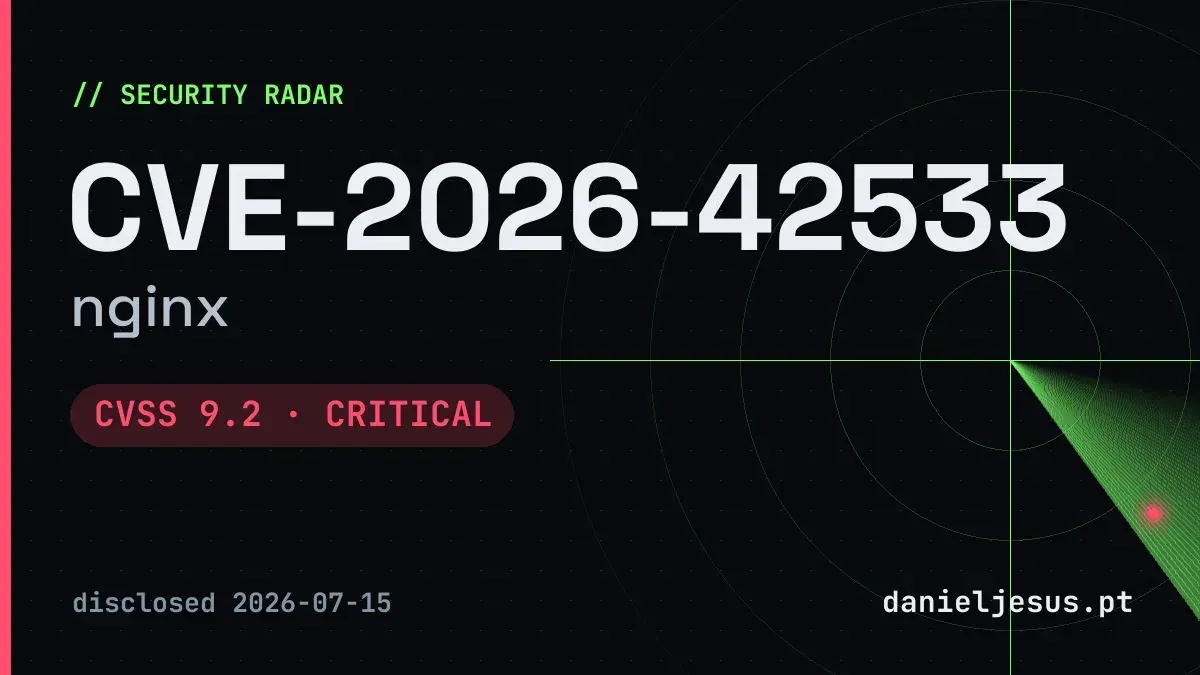
CVE-2026-42533: Critical Vulnerability in NGINX
CVE-2026-42533 affects multiple versions of NGINX, allowing DoS and potential code execution.
// on this page (8)
Introduction
The CVE-2026-42533 vulnerability affects NGINX Plus and NGINX Open Source, allowing unauthenticated attackers to cause a Denial-of-Service (DoS) or potentially execute code on vulnerable systems.
What happened?
This vulnerability arises when a map directive uses regex matching and a string expression references the map's regex capture variables before referencing the map output variable. This can lead to a heap buffer overflow in the NGINX worker process, causing the service to restart.
How the vulnerability works
The vulnerability is triggered by malicious HTTP requests that exploit how NGINX processes variables in string expressions. Under certain conditions, an attacker can manipulate these expressions to cause unexpected behavior on the server, resulting in a DoS or potential code execution, especially on systems where Address Space Layout Randomization (ASLR) is disabled.
What is the real impact?
The impact of this vulnerability is significant, as it may allow remote attackers to disrupt NGINX service availability (DoS) or, in specific scenarios, execute malicious code. It is important to note that there is no control plane exposure; this is solely a data plane issue.
Which versions are affected?
- nginx gateway fabric ≥ 1.3.0 ≤ 1.6.2
- nginx gateway fabric ≥ 2.0.0 < 2.6.7
- nginx ingress controller ≥ 3.5.0 ≤ 3.7.2
- nginx ingress controller ≥ 5.0.0 < 5.5.3
- nginx ingress controller ≥ 2026-lts-r1 < 2026-lts-r4
- nginx ingress controller 4.0.0
- nginx ingress controller 4.0.1
- nginx open source ≥ 0.9.6 < 1.30.4
- nginx open source ≥ 1.31.0 < 1.31.3
- nginx plus ≥ 37.0.0.1 < 37.0.3.1
- nginx plus ≥ r33 < r36
- nginx plus r36
How to fix
- Check the versions of NGINX you are using.
- Update to the fixed version as soon as it is available. Refer to the vendor's advisory for more information.
- Monitor your systems for anomalous behavior that may indicate exploitation of the vulnerability.
- Consider implementing additional security measures, such as web application firewalls, to protect your NGINX services.
Mitigation while you update
While it is not possible to apply the update, it is recommended to limit access to the NGINX server and monitor HTTP requests to identify suspicious patterns that may indicate attempts to exploit the vulnerability.
Conclusion
The CVE-2026-42533 vulnerability poses a significant risk to NGINX systems. It is crucial for system administrators and store owners to take proactive measures to mitigate the impact and ensure the security of their applications.
// Fontes
- NVD — CVE-2026-42533 nvd.nist.gov ↗
- CVE.org — CVE-2026-42533 cve.org ↗
- my.f5.com (vendor advisory) my.f5.com ↗