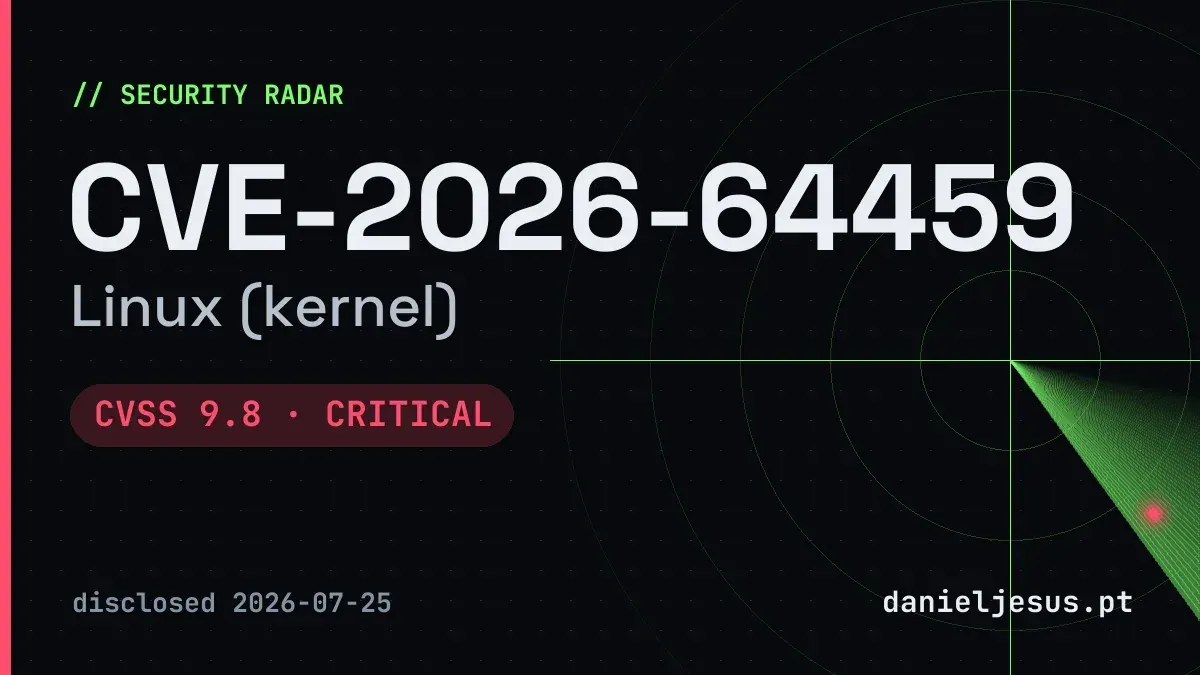
CVE-2026-64459: Critical Vulnerability in Linux Kernel
A critical vulnerability has been identified in the Linux kernel, affecting multiple versions.
// on this page (8)
Introduction
A critical vulnerability has been identified in the Linux kernel that may allow memory exploitation and cause system crashes. This vulnerability is particularly concerning due to its potential impact on systems running affected kernel versions.
What happened?
The vulnerability lies in how the Linux kernel manages the destruction of information related to TCP-AO (TCP Authentication Option). The removal of an RCU (Read-Copy-Update) callback in the tcp_ao_destroy_sock() function has resulted in the possibility that a pointer to memory about to be freed could be accessed by another process, leading to undefined behavior and potentially system crashes.
How does the vulnerability work?
When a TCP socket is in the TCP_SYN_SENT state, it is inserted into a hash table, making it accessible to other processes. The lack of synchronization between memory freeing and pointer updating may allow a process to access memory that has already been freed, resulting in a general protection fault. This can lead to system crashes and the execution of unauthorized code.
What is the real impact?
The impact of this vulnerability is considered critical, as it may allow an attacker to cause system crashes or execute malicious code. Systems running affected versions of the Linux kernel are at risk, especially in environments where security is paramount.
Which versions are affected?
- linux kernel ≥ 6.18 < 6.18.39
- linux kernel ≥ 6.19 < 7.1.4
- linux kernel 7.2
How to fix
- Check your Linux kernel version.
- Update to a patched version of the kernel as recommended by the vendor.
- Test the new version in a controlled environment before deploying it in production.
- Monitor systems after the update to ensure there are no issues.
Mitigation while you update
While updating is not possible, consider the following mitigation measures:
- Limit system access to authorized users only.
- Implement firewall rules to restrict unnecessary network traffic.
- Monitor system logs for abnormal behavior.
Conclusion
The CVE-2026-64459 vulnerability poses a significant risk to systems running affected versions of the Linux kernel. It is crucial for system administrators and store owners to perform the necessary updates to protect their environments against potential exploits.
// Fontes
- NVD — CVE-2026-64459 nvd.nist.gov ↗
- CVE.org — CVE-2026-64459 cve.org ↗
- Linux kernel (git) (patch) git.kernel.org ↗
- Linux kernel (git) (patch) git.kernel.org ↗
- Linux kernel (git) (patch) git.kernel.org ↗