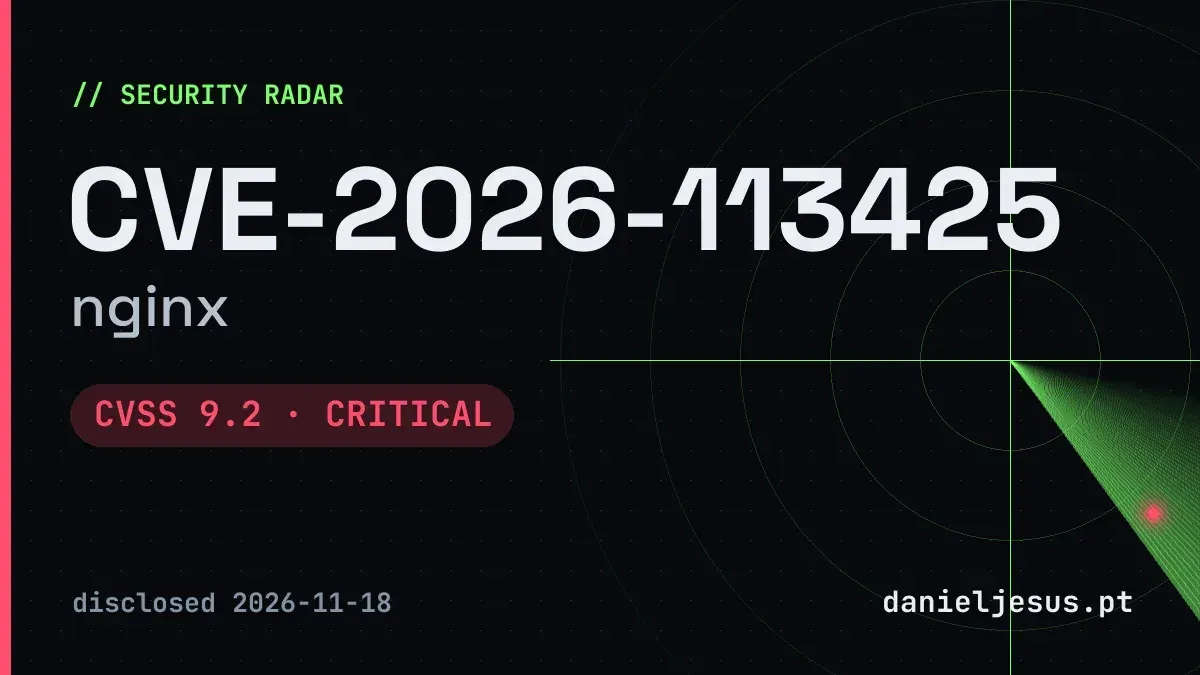
CVE-2026-113425: Critical Vulnerability in NGINX as Mail Proxy
Learn about the critical vulnerability in NGINX that may allow remote code execution.
// on this page (8)
Introduction
The CVE-2026-113425 vulnerability affects NGINX Plus and NGINX Open Source when configured as mail proxies. This critical flaw may allow remote code execution, jeopardizing system integrity.
What happened?
When NGINX is used as a mail proxy, undisclosed traffic can cause a use-after-free in an NGINX worker process. This can lead to service disruption or even the execution of malicious code, especially on systems where Address Space Layout Randomization (ASLR) is disabled.
How the vulnerability works
The vulnerability arises from a failure in memory management, where an NGINX worker process can be corrupted. An unauthenticated remote attacker can exploit this flaw to crash the process or corrupt memory, resulting in potentially severe consequences, such as remote code execution.
What is the real impact?
- Service disruption due to the crash of the NGINX worker process.
- Potential for remote code execution on vulnerable systems.
- Impact on the security and integrity of data managed by NGINX.
Which versions are affected?
The affected versions of NGINX have not been specified. It is advisable to check the latest information in the manufacturer's advisory.
How to fix
- Check the version of NGINX in use and identify if it is configured as a mail proxy.
- Consult the manufacturer's advisory for information on fixed versions.
- Update NGINX to the latest version that addresses this vulnerability.
- Test the configuration after the update to ensure the service is functioning correctly.
Mitigation while you update
- Disable the NGINX configuration as a mail proxy if it is not needed.
- Implement firewall rules to restrict unauthorized traffic to NGINX.
- Monitor NGINX logs for anomalous behavior.
Conclusion
The CVE-2026-113425 vulnerability poses a significant risk to systems using NGINX as a mail proxy. It is crucial for system administrators to take immediate action to update and mitigate the associated risks.
// Fontes
- NVD — CVE-2026-113425 nvd.nist.gov ↗
- CVE.org — CVE-2026-113425 cve.org ↗
- my.f5.com my.f5.com ↗