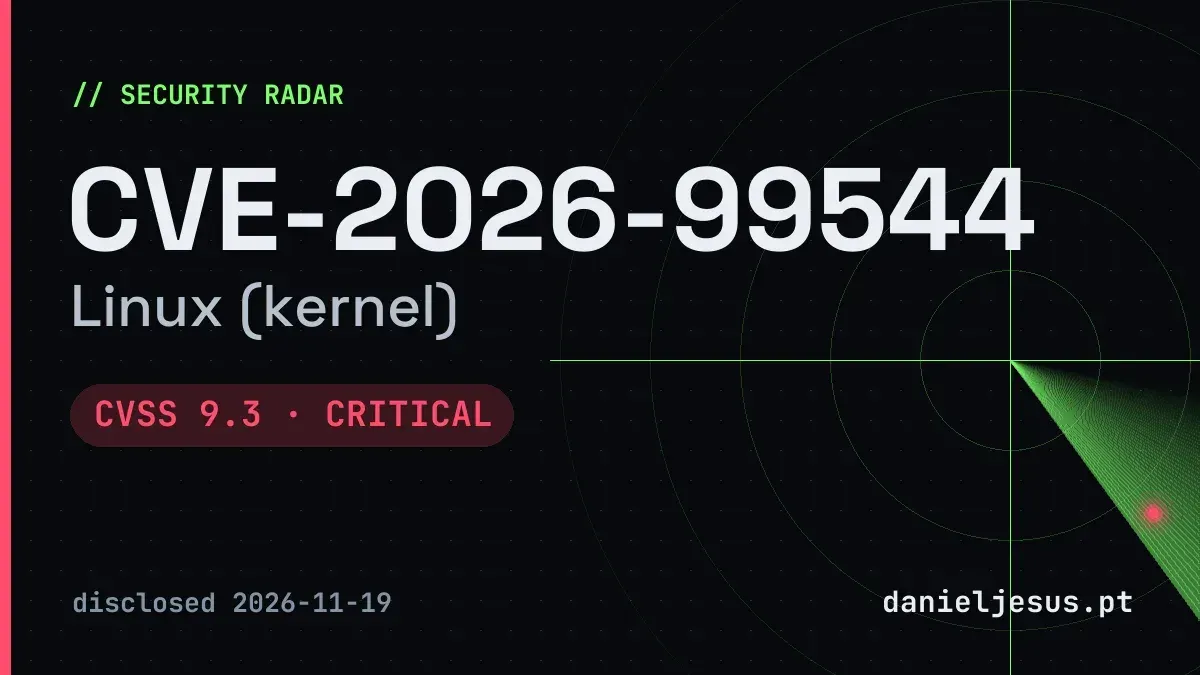
CVE-2026-99544 - Critical Vulnerability in the Linux Kernel
A critical vulnerability has been identified in the Linux kernel, affecting the security of virtual machines.
// on this page (8)
Introduction
A critical vulnerability has been identified in the Linux kernel, related to the handling of buffer indices in CoCo virtual machines. This flaw may allow an untrusted host to compromise the security of the guest system.
What happened?
In the Linux kernel, the function hv_ringbuffer_write() does not properly check the read and write indices of the shared buffer. This means that a potentially malicious host can manipulate these indices, leading to writing data to unauthorized locations, which can cause memory corruption and compromise the integrity of the guest system.
How does the vulnerability work?
The vulnerability lies in the lack of validation of the read and write indices used to access the shared buffer between the host and the virtual machine. Since these indices can be manipulated, an attacker can exploit this flaw to write data to memory locations that exceed the buffer limits, resulting in unexpected and potentially dangerous behaviors.
What is the real impact?
The impact of this vulnerability is considered critical, as it may allow an untrusted host to compromise the security of the guest system. This can result in data corruption, system failures, and ultimately the loss of confidentiality, integrity, and availability of the data stored in the virtual machine.
Which versions are affected?
- Versions of the Linux kernel unspecified.
How to fix
- Check if your Linux distribution has released an update for the kernel that addresses this vulnerability.
- Update the Linux kernel to the latest available version that contains the fix.
- Consider monitoring your vendor's security advisories for future related updates.
Mitigation while you update
While it is not possible to apply the update, consider the following mitigation measures:
- Limit access to the guest system to trusted users only.
- Implement additional security measures, such as firewalls and intrusion detection systems.
- Review the security configurations of your virtual environment to minimize risks.
Conclusion
It is crucial for system administrators and owners of Linux virtual machines to be aware of this vulnerability and take necessary steps to fix and mitigate the associated risks. Updating the kernel should be a priority to ensure the security of the virtual environment.
// Fontes
- NVD — CVE-2026-99544 nvd.nist.gov ↗
- CVE.org — CVE-2026-99544 cve.org ↗
- Linux kernel (git) git.kernel.org ↗
- Linux kernel (git) git.kernel.org ↗
- Linux kernel (git) git.kernel.org ↗
- Linux kernel (git) git.kernel.org ↗