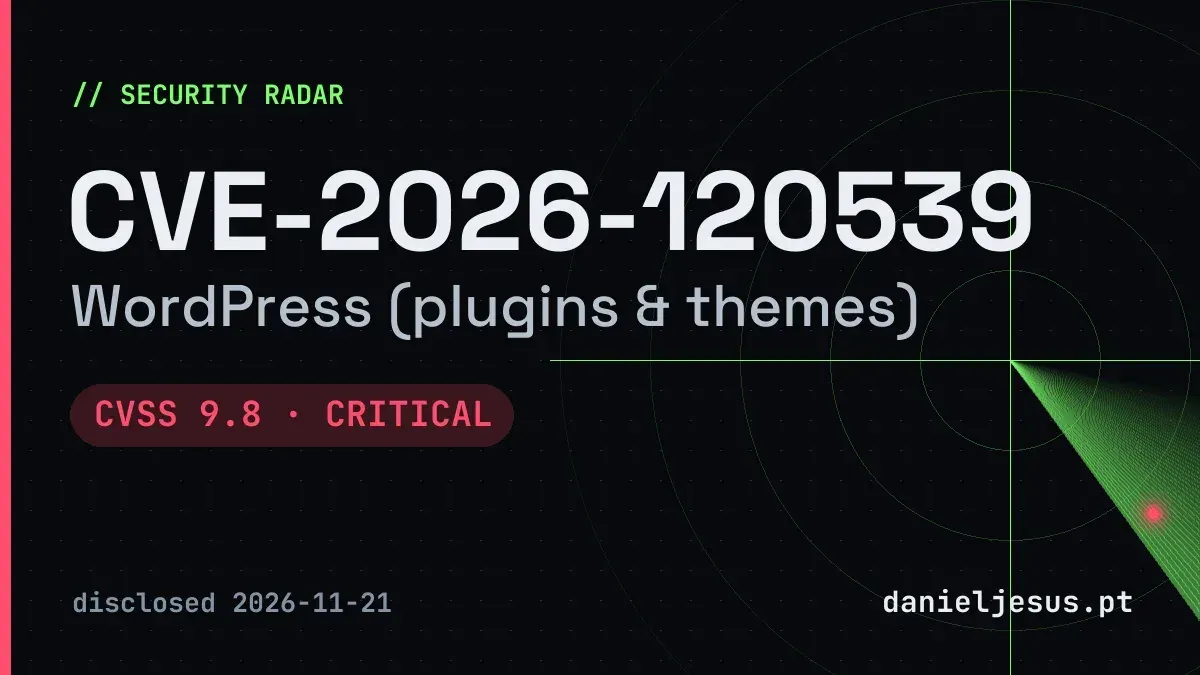
CVE-2026-120539 - Remote Code Execution Vulnerability in Restrictions for BuddyPress Plugin
The Restrictions for BuddyPress plugin for WordPress has a critical vulnerability that allows remote code execution.
// on this page (8)
Introduction
The Restrictions for BuddyPress plugin, used in WordPress sites, has a critical vulnerability that allows remote code execution. This flaw affects all versions up to 1.5.4 and can be exploited by unauthenticated attackers.
What happened?
The vulnerability arises from how the plugin handles request URIs. The plugin inserts the attacker-controlled URI into a PHP expression within a double-quoted string and evaluates it using eval(). Since PHP interpolates double-quoted strings, a payload in the form {${...}} in the URL is executed during interpolation, allowing arbitrary code execution on the server.
How does the vulnerability work?
When an attacker sends a GET request with a manipulated URI, the plugin processes this URI without adequate checks. Code execution occurs before any authentication checks, meaning the attacker does not need to be authenticated to exploit the vulnerability.
What is the real impact?
The impact of this vulnerability is severe, as it allows unauthenticated attackers to execute arbitrary code on the server. This can lead to significant security compromises, including the installation of malware, data theft, or complete control of the affected server.
Which versions are affected?
- Up to 1.5.4
How to fix
- Update the Restrictions for BuddyPress plugin to version 1.5.5 or higher.
- Ensure that the BuddyPress and Paid Memberships Pro plugins are also updated.
- Monitor the site for suspicious activities after the update.
Mitigation until you update
While it is not possible to update, it is recommended to disable the Restrictions for BuddyPress plugin to prevent exploitation of the vulnerability. Additionally, it is important to review access permissions and monitor server logs for any unauthorized activity.
Conclusion
The CVE-2026-120539 vulnerability in the Restrictions for BuddyPress plugin poses a significant risk to the security of WordPress sites. It is crucial for administrators to update the plugin to the patched version as soon as possible to protect their systems.
// Fontes
- NVD — CVE-2026-120539 nvd.nist.gov ↗
- CVE.org — CVE-2026-120539 cve.org ↗
- GitHub github.com ↗
- plugins.trac.wordpress.org plugins.trac.wordpress.org ↗
- plugins.trac.wordpress.org plugins.trac.wordpress.org ↗
- plugins.trac.wordpress.org plugins.trac.wordpress.org ↗
- plugins.trac.wordpress.org plugins.trac.wordpress.org ↗
- plugins.trac.wordpress.org plugins.trac.wordpress.org ↗
- Wordfence wordfence.com ↗