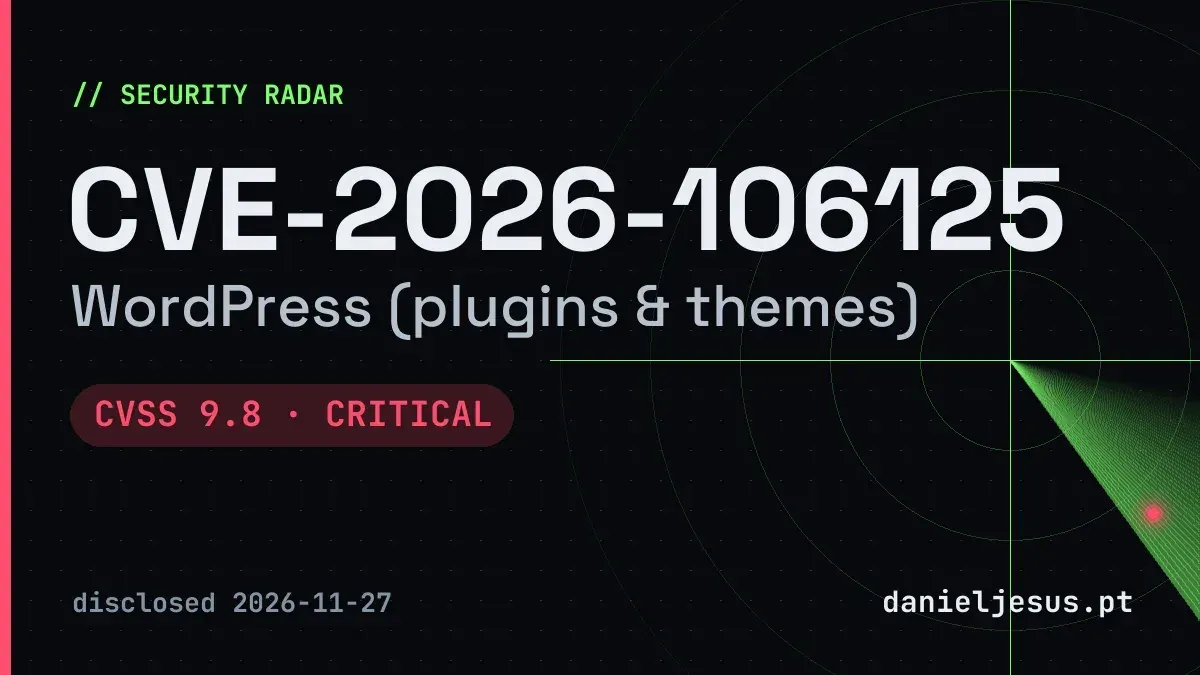
CVE-2026-106125: Critical Vulnerability in Sneeit Framework for WordPress
The vulnerability in Sneeit Framework allows remote code execution, affecting versions up to 8.7.
// on this page (8)
Introduction
The CVE-2026-106125 vulnerability affects the Sneeit Framework plugin for WordPress, allowing remote code execution. This flaw is considered critical and can have severe consequences for websites using this plugin.
What happened?
The Sneeit Framework, in versions up to 8.7, contains a vulnerability that allows an unauthenticated attacker to execute arbitrary PHP functions. This flaw occurs due to how the 'callback' parameter is handled in the sneeit_compact_menu_mega_content AJAX action. The handler sneeit_compact_menu_mega_content_callback() does not perform adequate authentication or authorization checks, allowing an attacker to exploit this vulnerability.
How does the vulnerability work?
The vulnerability arises from the use of the 'callback' parameter value directly in the call_user_func() function after a function existence check. Additionally, the argument passed to this function is also controlled by the attacker through a JSON-decoded parameter called 'args'. The lack of nonce verification and an allow-list of callable functions further increases the risk.
What is the real impact?
If exploited, this vulnerability could allow unauthenticated attackers to execute any existing PHP function in WordPress, potentially compromising the security of the site. This could result in unauthorized access, data theft, or even complete destruction of the site.
Which versions are affected?
- Up to 8.7
How to fix
- Check the version of the Sneeit Framework installed on your site.
- Update the plugin to the fixed version as soon as it becomes available. Confirm the fixed version in the vendor's advisory.
- Review access permissions and authentication for AJAX actions on your site.
- Consider disabling the plugin until a fix is available if immediate updating is not possible.
Mitigation while you update
While it is not possible to apply an update, it is recommended to disable the Sneeit Framework to prevent exploitation of the vulnerability. Additionally, implement further security measures such as web application firewalls and monitoring for suspicious activity.
Conclusion
The CVE-2026-106125 vulnerability in the Sneeit Framework for WordPress poses a significant risk to website security. It is essential for system administrators to take immediate action to mitigate this issue and ensure the security of their applications.
// Fontes
- NVD — CVE-2026-106125 nvd.nist.gov ↗
- CVE.org — CVE-2026-106125 cve.org ↗
- GitHub github.com ↗
- GitHub github.com ↗
- GitHub github.com ↗
- Wordfence wordfence.com ↗