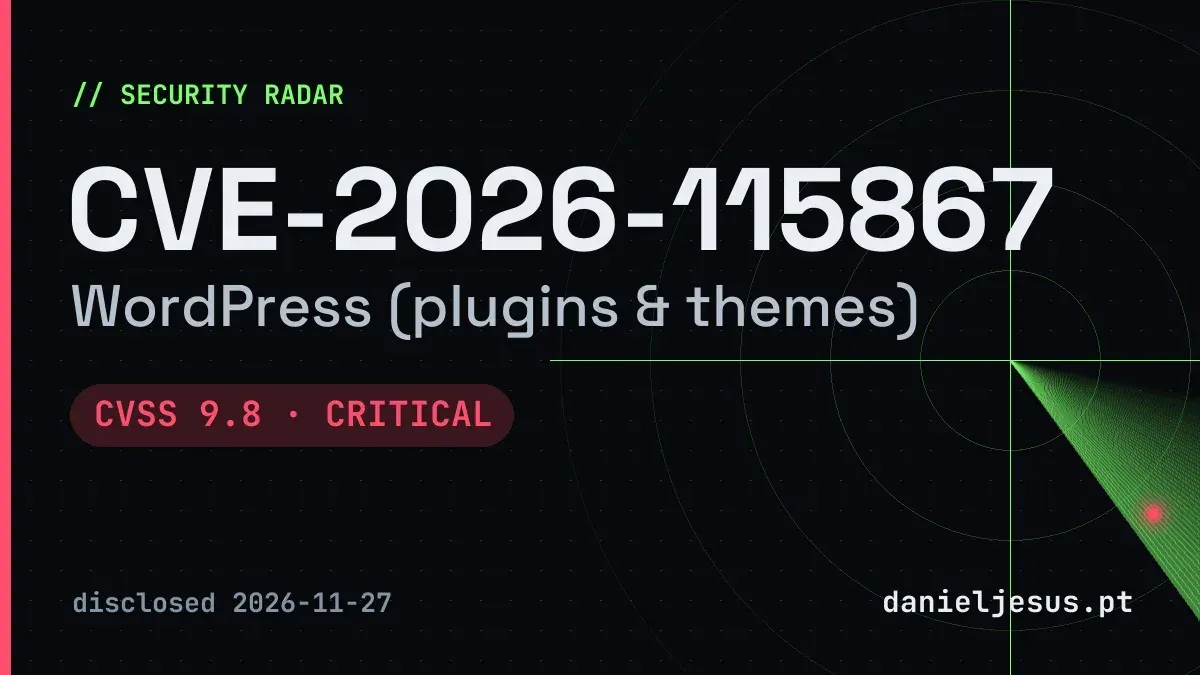
CVE-2026-115867: Arbitrary File Upload Vulnerability in WordPress
A critical vulnerability allows arbitrary file uploads in WordPress plugins.
// on this page (8)
Introduction
The CVE-2026-115867 vulnerability affects the Database for Contact Form 7, WPforms, and Elementor forms plugin for WordPress, allowing arbitrary file uploads. This critical flaw can have serious security implications for affected installations.
What happened?
The vulnerability was identified in the copy_files function, which does not properly validate file extensions. This allows unauthenticated attackers to upload potentially executable files, enabling remote code execution.
How the vulnerability works
The flaw arises from the lack of validation of file extensions in the copy_files function. The plugin accepts attacker-controlled stream wrapper URIs as the file source and derives the destination filename without restricting executable extensions. Although the plugin places an .htaccess file in the uploads directory to block PHP execution, this mitigation is ineffective on Nginx, LiteSpeed in certain configurations, and Apache servers with AllowOverride None.
What is the real impact?
The impact of this vulnerability is critical, as it allows unauthenticated attackers to upload executable files, which can lead to remote code execution and compromise the security of the site. This may result in data loss, compromise of sensitive information, and full control over the affected server.
Which versions are affected?
- All versions up to 1.5.5
How to fix
- Update the Database for Contact Form 7, WPforms, or Elementor forms plugin to the latest available version.
- Ensure that file extension validation is properly implemented.
- Monitor uploads and server logs for suspicious activity.
Mitigation while you update
While it is not possible to update, it is recommended to deactivate the affected plugin to prevent any exploitation of the vulnerability. Additionally, implementing firewall rules to block unauthorized file uploads is advisable.
Conclusion
The CVE-2026-115867 vulnerability poses a significant risk to the security of WordPress sites. It is crucial for system administrators and store owners to be aware of this flaw and take immediate action to protect their installations.
// Fontes
- NVD — CVE-2026-115867 nvd.nist.gov ↗
- CVE.org — CVE-2026-115867 cve.org ↗
- plugins.trac.wordpress.org plugins.trac.wordpress.org ↗
- plugins.trac.wordpress.org plugins.trac.wordpress.org ↗
- plugins.trac.wordpress.org plugins.trac.wordpress.org ↗
- plugins.trac.wordpress.org plugins.trac.wordpress.org ↗
- Wordfence wordfence.com ↗