// case study — 2025
Encontros com Vinho
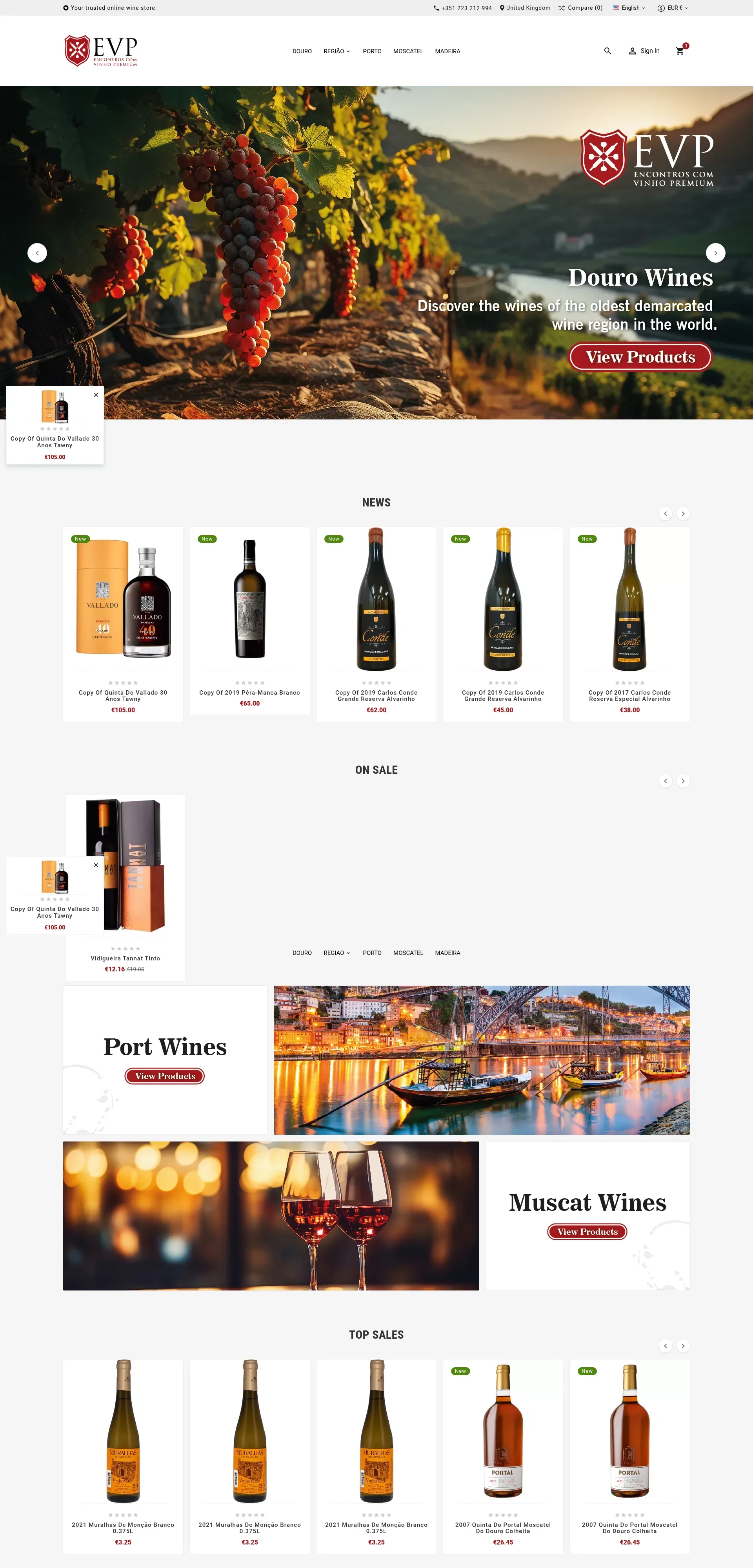
I developed Encontroscomvinho.pt, an online wine store built with PrestaShop and WooCommerce technologies. The project included platform migration, web design, technical SEO, geolocation, international VAT rules, payment and shipping APIs, performance optimization and cybersecurity.
DevelopmentE-commerceMaintenancePerformance OptimizationSecuritySystems Administration
 // client — Encontros com Vinho Premium →

// on this page (17)
Project: Encontroscomvinho.pt — Online wine store and eCommerce platform
Development: Complete eCommerce development, platform migration, web design, SEO, internationalization, API integrations, infrastructure and cybersecurity.
Tech Stack: WordPress, WooCommerce, PrestaShop, PHP, MySQL, HTML, CSS, JavaScript and API integrations.
Buying wine online seems straightforward. You choose a producer, look for a particular vintage, add a few bottles to your basket and complete your order. Developing an online store that handles all these steps correctly, especially when selling to customers in different countries, is a different story.
That was the challenge behind encontroscomvinho.pt, the eCommerce project developed for Encontros com Vinho Premium, a Portuguese company specializing in wine distribution and retail.
I was responsible for the complete development of the online store, including migration from a previous platform, product catalogue organization, visual design, search engine optimization, international tax rules and the integrations required to support the business.
My work also covered system administration, performance optimization and cybersecurity. After all, an online store depends on much more than what customers see on their screens. Behind every order is an infrastructure that needs to work reliably.
The goal was to create an eCommerce platform suited to EVP's business, capable of presenting wines from different producers and supporting sales across multiple markets while keeping the purchasing process as straightforward as possible.
The Challenge: Bringing Wine Distribution into eCommerce
Encontros com Vinho Premium works with wines from different producers and Portuguese wine regions. Alongside the variety of brands, each product has a considerable amount of associated information.
A wine may have several vintages, different bottle sizes, protected designations of origin and characteristics that distinguish it from other products by the same producer.
All this information needs to be organized so customers can find what they are looking for, while allowing the company to manage its catalogue without unnecessarily complicated processes.
International sales added another layer of complexity.
An order shipped to Portugal does not necessarily follow the same tax rules, payment requirements or delivery conditions as an order sent to Spain, France or another country.
And because the products are alcoholic beverages, shipping and commercial restrictions require additional attention to delivery conditions and destination markets.
The challenge was to bring together product information, the shopping experience, commercial rules and technical infrastructure within a single platform, without making the experience complicated for customers.
WordPress, WooCommerce and PrestaShop — The Technology Behind the Project
Throughout my work on encontroscomvinho.pt, I used technologies from the WordPress and WooCommerce ecosystem, alongside PrestaShop, a dedicated eCommerce platform.
These solutions approach online commerce differently. WooCommerce extends WordPress with eCommerce functionality, while PrestaShop was specifically designed to manage online stores, product catalogues, customers and orders.
For this project, the work went beyond installing a platform and customizing a visual theme. The technology had to be adapted to the company's commercial requirements.
That involved configuring and developing functionality related to product management, pricing, tax rules, countries, shipping carriers, payments and product presentation.
It was also important to prepare the store for future changes, allowing products and business settings to be managed without affecting the rest of the application.
These technologies formed part of a broader development process in which the application, database and hosting infrastructure were treated as interconnected components of the same project.
Platform Migration — Preserving Data and Rebuilding the Catalogue
One of the major stages of the project involved importing data from a previous eCommerce platform.
Migrating an online store involves considerably more than exporting a file and importing it into another system.
Different platforms store information in different ways. Categories, products, attributes, images, internal references and database relationships do not always have direct equivalents.
I had to work with the data structures to ensure the information could be used correctly within the new platform.
For an online wine store, this requires particular care. A product is not identified solely by its name: the vintage, producer, wine type and bottle capacity are essential characteristics that distinguish individual references.
The catalogue preparation needed to respect these differences, preventing similar products from being confused or important information from losing its context during migration.
I also paid attention to category organization and how products would appear within the new store.
The objective was not simply to transfer information between systems, but to use the migration as an opportunity to build a more organized database suited to the intended shopping experience.
Product Catalogue Architecture — Regions, Producers and Vintages
An online wine store requires a different navigation structure from a general-purpose eCommerce website.
Customers may begin their search with a wine region, a producer or a specific label. Others may only know the grape variety or want to find a particular vintage.
I worked on the catalogue architecture to support these different ways of browsing and searching.
Categories allow visitors to explore wines from the Douro, Alentejo, Dão, Bairrada, Vinho Verde and other Portuguese wine regions, alongside Port, Madeira and Moscatel wines.
Product information can include the producer, vintage, price and other relevant commercial characteristics.
The structure was designed to help customers find specific wines without navigating through unnecessary pages.
Catalogue organization also plays an important role in SEO, as it creates category pages with clearly defined subjects and logical relationships between different levels of the website.
For me, information architecture always has two responsibilities: making the store easier to use and helping search engines understand the content it contains.
Web Design and Visual Identity — An Online Wine Store for Every Screen
The project also included web design, visual identity and user experience.
Product photography is particularly important in an online wine store. Labels, bottle shapes and visual presentation help customers recognize the wines they are looking for.
But good photography is not enough on its own.
The interface needed to give the catalogue the attention it deserved, make navigation straightforward and create a natural transition between product pages and the shopping basket.
I worked on the store's visual presentation, content hierarchy, interface elements and responsiveness across different screen sizes.
The experience on mobile devices was particularly important. Browsing a wine catalogue on a smartphone requires a different layout from the one used on a large desktop monitor.
My aim was to balance the brand's visual identity with functionality. Customers should be able to identify a wine, review its relevant characteristics and proceed with their purchase without unnecessary distractions.
The intended result was a store with its own personality, but simple enough that the technology never got in the way of finding and purchasing products.
Geolocation — Adapting the Store to Each Customer's Country
One of the most important technical components was geolocation and adapting the shopping experience to different destination markets.
International eCommerce involves much more than allowing customers from other countries to enter a shipping address.
Commercial presentation, tax rules, available shipping carriers and delivery conditions can all change depending on the destination.
I worked on the geographical location logic to help the store present an experience better suited to the visitor's country.
The selected market influences several aspects of the operation, from pricing and tax configurations to available delivery services.
It was important to distinguish between the visitor's initially detected location and the actual delivery address, since someone browsing from one country may want an order delivered to another.
The platform therefore needed to use the correct destination information when applying the relevant commercial rules.
The challenge was to make the store adaptable to different markets while maintaining a consistent purchasing experience.
International VAT — Different Tax Rules for Different Countries
Configuring VAT rules for multiple countries was another important part of the development work.
Once an online store begins selling internationally, tax calculations become more complicated than simply applying a single domestic VAT rate.
I worked on tax rules associated with different destination markets, allowing the platform to use the appropriate configurations for each country.
These settings directly affect order totals, price presentation and the checkout process.
It was also important to ensure that the different components of an order, including products, taxes and shipping, were handled consistently.
The tax logic was incorporated into the store's commercial configuration, supporting different rules depending on the destination and the conditions of each order.
The goal was to avoid generic calculations that might create discrepancies between the amounts presented to customers and the values applicable to their orders.
In an international eCommerce platform, this is one of those areas that customers rarely notice when everything works correctly, but one that can create significant problems when implemented incorrectly.
Online Payments — API Integrations and Customer-Friendly Methods
The checkout was another area that required development and integration work.
An online store can have an excellent catalogue and an attractive design, but if customers encounter problems during payment, the entire shopping experience suffers.
I integrated payment services through APIs, allowing the platform to communicate with the external systems involved in processing transactions.
The store supports payment methods including Multibanco references, MB WAY, bank transfers and PayPal, giving customers different options depending on their preferences.
Payment integration involves more than displaying a button during checkout.
The order information needs to be transmitted correctly, amounts must remain consistent and payment status information must be handled by the application.
It is also necessary to consider cases where a payment is not completed, a customer abandons the process or an external service returns an unexpected response.
These situations are part of developing a reliable commercial platform and require careful handling of communication between systems.
I wanted to make payment as straightforward as possible for the customer, keeping the complexity of the integrations within the application itself.
Shipping Carriers — API Integrations and Location-Based Delivery Rules
Shipping wine introduces particular requirements that need to be considered when developing an online store.
Glass bottles are fragile, have weight and require appropriate packaging. Shipping costs and available services also vary depending on the destination.
I developed the integration with shipping carriers through APIs, connecting logistics services with the store's commercial and geographical rules.
The system needed to consider the available destinations and present delivery conditions appropriate to each order.
This involved working with customer information, shipping addresses, geographical location and the relevant transport services.
The resulting logic supports different destination markets without relying on a single shipping configuration for every country.
The store presents different delivery conditions for mainland Portugal, Madeira, the Azores, Spain, other European countries and additional international destinations.
For the business, these integrations help organize logistics. For customers, they provide delivery options related to their chosen destination during checkout.
Technical SEO — Building a Search-Friendly eCommerce Platform
Search engine optimization was part of the development process from the initial organization of the store.
An online wine catalogue can attract very different types of searches. Someone may search for the exact name of a wine, a particular vintage, a producer or a general category associated with a wine region.
The website needed a structure capable of supporting these different search intentions.
I worked on page organization, category hierarchy, titles, descriptions and the presentation of product information.
The platform migration also required particular consideration, since changes to URL structures can affect search engine indexing and existing organic visibility.
The catalogue architecture was designed to make products easier to discover through both internal navigation and search engine results.
Another important aspect was avoiding unnecessary confusion in the website structure when displaying similar products, filtered results and different navigation contexts.
The project also included image and performance optimization, both of which contribute to the overall user experience and page loading behavior.
The objective was not simply to add keywords to pages. It was to build a technically organized online store with relevant content and a structure that search engines could understand.
Performance Optimization — Keeping the Store Responsive
Performance optimization was another important area of my work.
Online stores include several components that can affect loading times: product images, filtering systems, shopping baskets, customer sessions, database queries and external integrations.
When these components are not properly considered, a platform can become slower, particularly as its catalogue grows.
I worked on application efficiency and resource usage, aiming to reduce unnecessary operations and improve the browsing experience.
Particular attention was given to image presentation, content loading, category and product pages, and infrastructure response times.
It was also important to recognize that different pages within an online store have different technical requirements.
A category page can be handled differently from a shopping basket, where information is associated with a specific customer session and the current state of an order.
Performance therefore had to be considered alongside application functionality, rather than treated as a collection of visual improvements.
A responsive online store should maintain good performance throughout everyday operations, including browsing, searching and completing purchases.
System Administration — The Infrastructure Behind the Store
My involvement in encontroscomvinho.pt did not end with application development.
I was also responsible for system administration, supporting the technical environment required to run the online store.
An eCommerce application depends on several components: a web server, PHP, a database, file storage, communication services and network configurations.
These systems must work together correctly, with resources appropriate to the application's requirements.
I worked on the configuration and maintenance of the hosting environment, considering service stability, performance and security.
Infrastructure management also matters during updates, maintenance operations and changes to application functionality, as certain modifications can affect components directly involved in order processing.
Having control over this technical layer allowed me to approach the project beyond its source code, connecting application behavior with the systems supporting it.
For me, developing an online store also means understanding and preparing the environment where it will operate.
Cybersecurity — Protecting Customers, Orders and Integrations
An online store processes information that requires appropriate protection.
Customer accounts, personal information, addresses, orders and communication with external payment and shipping services all introduce security considerations.
For this reason, cybersecurity was considered throughout the development and administration of the platform.
My work included attention to security configurations, access permissions, application protection and maintenance of the technologies involved.
External integrations also require their own security considerations, particularly when handling credentials and communication between services.
Another important factor is the management of software updates and third-party components. On platforms based on WordPress, WooCommerce or PrestaShop, maintaining control over software versions and updates helps reduce the attack surface.
Online store security cannot be reduced to a single tool or configuration.
It depends on a combination of technical decisions, from the application to the server, that need to be considered throughout the project's lifecycle.
The objective was to reduce risks without compromising usability or the normal operation of the store.
API Integrations — Connecting the Store to External Business Services
One of the areas that best illustrates the technical complexity of encontroscomvinho.pt is its communication with external services.
The platform supports different commercial requirements that cannot always be handled through the standard features of an eCommerce system.
Payment and shipping APIs provide the connection between the store and the external providers responsible for these services.
The development work needed to account for transmitted data, operation parameters and how the application processes responses from external systems.
It is also important to handle situations where an API returns an error, takes longer than expected or provides information that needs validation.
These situations can have a direct impact on checkout behavior and order management.
I worked on integrating external services into the store's commercial processes, keeping customers from having to deal with the technical operations taking place behind each action.
This type of development is what turns a standard eCommerce installation into a solution adapted to the requirements of a particular business.
An International Shopping Experience Without Unnecessary Complexity
By combining geolocation, VAT rules, payments and shipping carriers, the project developed an international component that went well beyond translating website content.
The store provides Portuguese and English versions, allowing customers from different markets to browse the catalogue and explore its products.
The availability of different display currencies, including EUR and USD, adds to this experience.
However, international eCommerce requires the commercial presentation to remain consistent with the conditions applicable to each order.
For that reason, I worked on the relationships between countries, prices, taxes, payment options and delivery services.
The challenge was to prepare the platform to handle these differences without requiring customers to configure every technical detail of their purchase.
I wanted customers in Portugal and customers in other countries to have an equally straightforward shopping experience, even when the commercial rules behind their orders were different.
The Result — An Online Store Adapted to the EVP Business
Encontroscomvinho.pt brings together several areas of my professional work within a single project: Full Stack Development, eCommerce, SEO, Web Design, Performance Optimization, System Administration and Cybersecurity.
The development included preparing the eCommerce platform, migrating information, reorganizing the product catalogue, implementing the visual identity and configuring the commercial rules required for selling wines to different markets.
It also involved payment and shipping integrations, geographical adaptation, international taxation and the supporting infrastructure.
The result is an online wine store where customers can browse wines by region, producer or reference, view product information and place orders through an eCommerce experience designed around the business.
For Encontros com Vinho Premium, the platform provides an additional sales channel, complementing its distribution activities and making its catalogue available to customers searching for Portuguese wines online.
From my perspective, it was a project that required understanding the business as a whole, rather than treating the website, payments, logistics and infrastructure as unrelated technical problems.
More Than Building an Online Store — Understanding the Business
Encontroscomvinho.pt is a good example of what I consider important in eCommerce development.
An online store can have an attractive design and a comprehensive product catalogue, but that means little if prices are calculated incorrectly, delivery services are not adapted to each destination or the infrastructure cannot support the application's requirements.
Throughout this project, I worked on these different areas, from data migration to checkout, including SEO, integrations, performance and security.
The technologies were important, but the decisions always had to reflect the actual commercial requirements of Encontros com Vinho Premium.
The biggest challenge was not any individual feature. It was making several components, each with different requirements and behavior, work together as a coherent system.
That is exactly the part of development I enjoy most: understanding the problem, finding the appropriate technical solution and building something that can be used in everyday business operations.
Because developing an online store is not simply about putting products up for sale. It is about building the technology that allows a business to sell, operate and grow with confidence.
// project details
- year
- 2025
- platform
- WordPress · WooCommerce · PrestaShop
- role
- Fullstack Developer
- System Administration
- Security Analyst
- Performance Optimization
- Maintenance & Support
- stack (27)
-
- PHP
- PHP-FPM
- WordPress
- MySQL
- HTML
- CSS
- JavaScript
- jQuery
- WooCommerce
- PrestaShop
- Smarty
- Symfony
- Linux
- Bash
- Nginx
- Apache
- LiteSpeed
- MariaDB
- Cloudflare
- SSH
- Cloudflare WAF
- ModSecurity
- Fail2ban
- Let's Encrypt
- Redis
- OPcache
- Cloudflare CDN