// case study — 2026
FutPulse
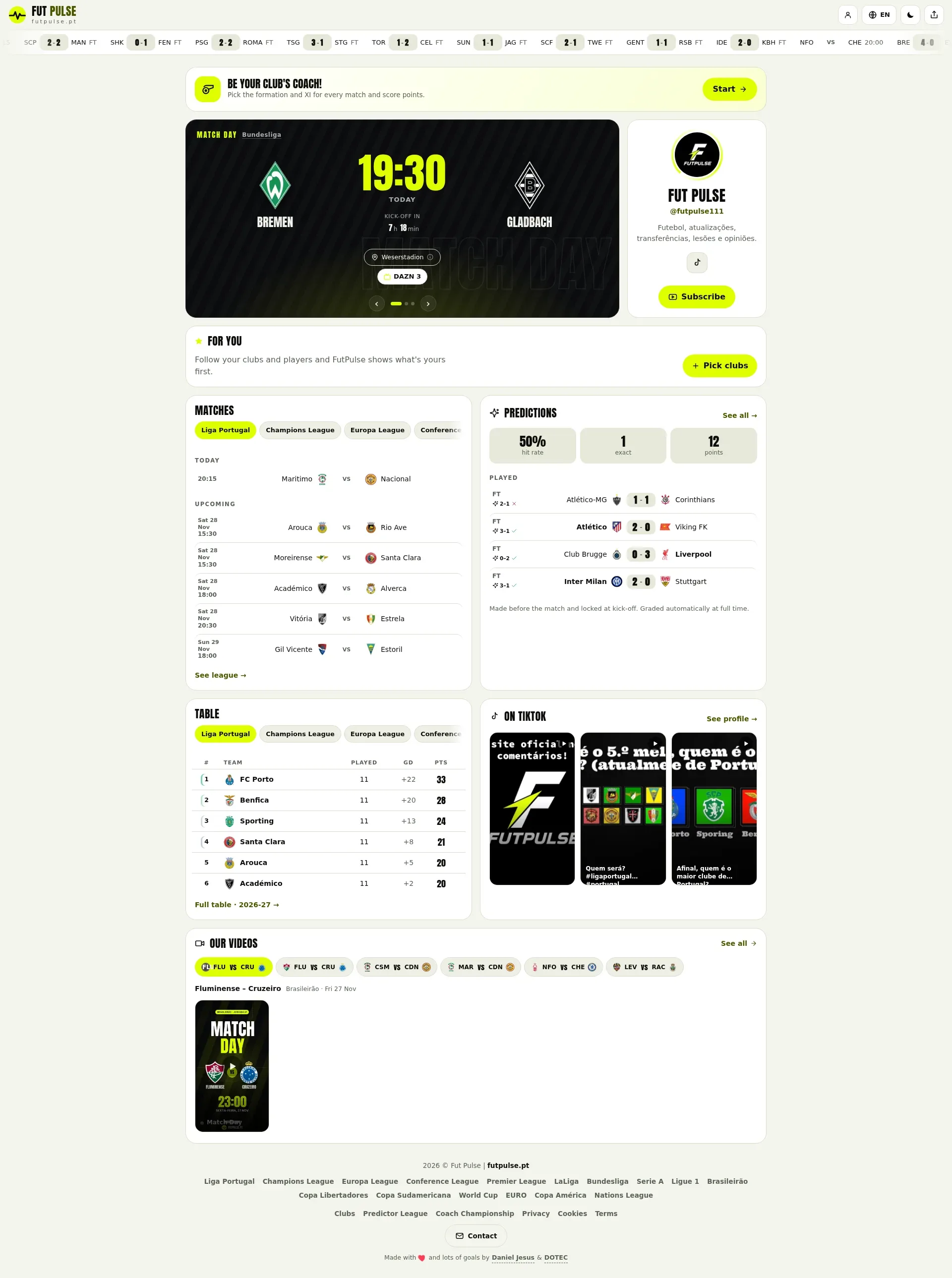
I developed FutPulse.pt, a football platform featuring results, statistics, predictions and interactive competitions. The project includes sports API integrations, Android and iOS applications, caching systems, server infrastructure, two-factor authentication, cybersecurity and custom development.
AutomationDesign & FrontendDevelopmentMaintenanceMicroservicesPerformance OptimizationSecuritySEOSystems Administration
 // client — Dotec →

// on this page (23)
Project: FutPulse.pt — Football information platform, sports data and mobile applications
Development: Custom software development, sports API integration, football results and statistics, Android and iOS applications, two-factor authentication, caching systems, push notifications, server administration, cybersecurity and infrastructure.
Tech Stack: Full Stack Web Development, APIs, databases, JavaScript, HTML, CSS, caching systems, Cloudflare, multi-factor authentication, push notifications, server infrastructure and mobile integration.
Anyone who follows football knows how easy it is to waste time looking for information. Results are in one app, league tables in another, news appears on social media, and finding a particular player's statistics or a team's upcoming fixtures often means visiting several websites.
That's the kind of experience I wanted to improve with FutPulse.pt, a football portal bringing together results, fixtures, league tables, statistics, clubs, players and information from different national and international competitions.
I've been responsible for the technical design and development of the project, from the application and its sports data integrations to the infrastructure supporting the platform.
My work covers custom software development, API integration, data organization, performance optimization, caching systems, server administration and cybersecurity.
I've also worked on the mobile experience, including development related to Android and Apple iOS applications, and implemented authentication and security mechanisms, including two-factor authentication for administrative access.
But FutPulse is more than a place to check football scores. The platform includes interactive features such as the Prediction League and the Manager Championship, where supporters can participate, make selections and follow their performance.
For me, the most interesting challenge was building a platform capable of collecting information from different services, organizing it and presenting it clearly without passing the technical complexity on to the people using it.
The Challenge — Bringing Football Information Together
Football generates an enormous amount of information every day.
Matches take place across different time zones, competitions have their own schedules, scores change during games, league tables need updating, and statistics are associated with clubs, players and individual matches.
The same team may also participate in several competitions, with information that needs to be correctly connected.
A club can have domestic fixtures, European matches, squad information and news published by different sources.
The challenge behind FutPulse was bringing this information together and developing a navigation structure that made it easy to explore.
I needed to build mechanisms for retrieving information from external services, handling different data structures and displaying the results in the appropriate sections of the portal.
Data organization is particularly important in a project like this. A score must belong to the correct match, a player to the appropriate team, and a league table to the relevant competition and season.
The goal was to create a portal where information is connected and easy to find, without requiring supporters to search for the same details across several platforms.
Custom Development — A Platform Built Around Its Requirements
FutPulse is a custom web development project, with features designed specifically for the portal.
Unlike an online store, where established eCommerce platforms provide many of the essential commercial features, a football information portal requires its own structure for managing competitions, teams, players, fixtures and statistics.
I worked on organizing the application, defining relationships between different types of information and developing the mechanisms required to present regularly updated content.
A club page, for example, has different requirements from a competition page.
While one might display a squad, upcoming fixtures, transfers and team statistics, the other needs to organize league tables, schedules and results involving several clubs.
Custom development makes it possible to adapt each area to its purpose rather than relying on generic functionality that may not be suitable.
I also developed interactive components, participation systems and integrations with external services, aiming to maintain a consistent experience throughout the platform.
Sports APIs — Integrating Data from Different Sources
One of the most important parts of FutPulse is its sports API integration.
APIs allow applications and services to exchange information through structured requests and responses.
In football, these integrations are particularly useful for retrieving information about competitions, fixtures, teams, players, scores and statistics.
However, the challenge involves more than making a request to an external service and displaying the response.
Different providers may use their own identifiers, data structures and update intervals depending on the information being requested.
I worked on processing and organizing this information so the platform could use it consistently.
For example, the same club may appear in several competitions and external systems. The application needs to connect that information without creating unnecessary duplicates or displaying it in the wrong context.
It is also important to handle situations where an API becomes unavailable, returns incomplete information or changes its response structure.
My development work included these integrations and the mechanisms required to transform external data into useful content within the portal.
For someone visiting FutPulse, the experience should be straightforward: open a page and find the information properly organized. The communication between systems should remain behind the scenes.
Football Scores and Fixtures — Information That Never Stands Still
One of FutPulse's central features is the presentation of football scores and fixtures.
The portal covers competitions including Liga Portugal, the UEFA Champions League, Europa League, Conference League, Premier League, LaLiga, Bundesliga, Serie A, Ligue 1 and Brasileirão, among others.
Visitors can explore scheduled matches, previous results and information associated with different competitions.
This requires particular attention to match dates and statuses.
A fixture may be scheduled, in progress, postponed or completed. The information displayed needs to reflect the status provided by the relevant data source.
Time zones are another consideration, especially when a portal covers competitions across different continents.
I worked on organizing this information to support browsing by competition or team, maintaining clear relationships between fixtures, results and individual match pages.
It's an area where the quality of the experience depends just as much on correct data processing as it does on visual presentation.
League Tables and Statistics — Turning Data into Useful Information
Another important component is the presentation of league tables and football statistics.
A league table contains considerably more information than the number of points each team has accumulated.
Matches played, wins, draws, defeats, goals scored, goals conceded, goal difference and performance throughout the season all help explain a club's position.
At FutPulse, I worked on presenting this information in an organized format, allowing visitors to explore competitions and compare teams.
The portal also includes information about goalscorers, assists and other statistics associated with players and matches.
One of the technical challenges is maintaining the relationship between the information displayed and the correct season or competition.
Data from different contexts must not be mixed, and statistics need to retain the references required to understand them.
This is part of the platform's underlying data organization and is just as important as the tables and visual elements displayed in the browser.
Clubs and Players — Connecting Related Information
FutPulse doesn't simply display lists of matches. I also developed pages dedicated to football clubs and players.
Club profiles bring together upcoming fixtures, previous results, squads, statistics, transfers, news and stadium information.
This is one of the areas that best demonstrates the importance of having a well-organized data structure.
The same club may be associated with different competitions, players, managers and events throughout a season.
Building a useful profile requires connecting these different datasets and presenting each piece of information in the correct context.
Updates also matter. Players change clubs, managers are replaced and transfers alter squad composition.
My work involved developing these pages and integrating the information required to populate them.
The idea is to let visitors explore a club or player without constantly switching between unrelated websites.
The Prediction League — An Interactive Experience for Supporters
I also wanted FutPulse to offer more than traditional sports information.
One of the platform's interactive features is the Prediction League, where users can predict football results and collect points based on the actual outcomes.
The scoring rules award three points for an exact score and one point for correctly predicting the winner or a draw.
Leaderboards allow participants to compare their performance across different periods, including weekly, monthly and seasonal rankings.
Developing this functionality requires connecting user predictions with completed match results.
Participation rules, prediction deadlines and leaderboard updates also need to be considered.
The feature includes user profiles, nicknames and mechanisms for following other participants, introducing a community element to the platform.
It turns match data into a participatory experience, allowing supporters to engage with football beyond simply checking the results.
The Manager Championship — Choosing Tactics and Starting Lineups
Another custom feature is the Manager Championship.
Here, users can select a club, choose a tactical formation and pick the players they expect to feature in a particular match.
Once the game ends, the system awards points according to what actually happened on the pitch.
The scoring model considers factors including players who started the match, the formation used, individual player ratings and the selection of unavailable players.
Developing this functionality involves connecting squad information, fixtures, starting lineups, match results and custom scoring rules.
One of the important considerations is preserving the selections made before kickoff, preventing them from being changed after the actual lineup or result is known.
It is also necessary to consider that lineup information can become available at different times depending on the sports data source.
The aim was to develop an interactive experience where supporters can test their knowledge of their teams and see how their decisions perform.
Match Predictions and Automatic Scoring
The portal also includes a section dedicated to football match predictions.
FutPulse predictions are published before matches and subsequently compared with the final results.
The system displays the original prediction, the actual outcome and performance indicators including correct predictions, exact scores and accumulated points.
This requires attention to the timing and integrity of the information.
A prediction needs to remain associated with the moment it was created, avoiding subsequent changes that could undermine its historical accuracy.
Once a match finishes, the prediction can be compared with the recorded result and evaluated according to the established scoring rules.
Although the feature is visible through a relatively straightforward interface, it requires its own processing logic, data persistence and calculation mechanisms.
It's a good example of how custom development allows a platform to go beyond merely displaying information received from APIs.
Android and iOS Applications — Bringing Football to Mobile Devices
An important part of FutPulse development involves the experience on Android and Apple iOS devices.
Football is followed in many different situations: at work, while travelling, at home or during a live match.
I wanted the platform to work naturally on smartphones, with touch-friendly navigation and layouts adapted to different screen sizes.
The project includes development work directed towards Android and iOS applications, alongside a web experience that can be installed on a device's home screen.
This approach brings the portal closer to the everyday experience of using an app, offering quick access to its features and an interface prepared for mobile use.
Mobile development also requires attention to communication with the portal's services, session management, permissions and notifications.
One of my priorities is maintaining a consistent experience across platforms rather than introducing completely different behaviour for the same functionality.
The goal is to let users follow their clubs, matches and competitions from the devices they use every day.
Push Notifications — Receiving the Information That Matters
FutPulse also offers push notifications, allowing users to choose which updates they want to receive.
Notifications can be particularly useful in football because important events don't necessarily happen when someone is actively browsing the portal.
However, there's an important difference between keeping people informed and overwhelming them with alerts.
I wanted this feature to respect user preferences, allowing notifications to be enabled or disabled.
Integrating notification services involves communicating with the mechanisms provided by browsers and mobile platforms.
It also requires handling permissions and the technical identifiers used to deliver messages to devices.
The system was designed with privacy in mind, avoiding unnecessary collection of personal information simply to send notifications.
It's a relatively discreet feature in the interface, but one that requires coordination between the application, infrastructure and external services.
User Accounts, Authentication and Session Security
Interactive features require mechanisms to identify users and associate their selections with the correct accounts.
FutPulse supports optional user accounts, allowing information such as favourite clubs, predictions and preferences to be maintained across devices.
The portal provides authentication options through services such as Google, Facebook and Apple, as well as email-based login codes.
These integrations require careful session handling and consideration of how different authentication methods relate to the same user experience.
Personal information, external account identifiers and account deletion mechanisms also need attention.
The goal was to support personalized functionality without requiring every visitor to register simply to browse publicly available football information.
At the same time, areas that allow information to be changed require appropriate authentication and access controls.
Two-Factor Authentication — Protecting Administrative Access
One of the security measures implemented was two-factor authentication (2FA) for administrative access.
Administrative interfaces provide capabilities that aren't available to ordinary visitors.
Depending on their purpose, they may allow access to content management, configurations, integrations and other important parts of the platform.
That's why protecting these areas requires additional care.
Two-factor authentication adds another verification step during login, reducing reliance on a password alone.
This complements access permissions and the other security controls used within the portal's environment.
For me, it's important to distinguish between protecting visitor accounts and protecting administrative tools.
Not every user needs the same level of access, and security measures should reflect the responsibilities of each part of the application.
Caching Systems — Reducing Requests and Processing
One of the most important technical components of FutPulse is its use of caching systems.
For a portal covering several competitions, it makes little sense to query every external data source whenever someone opens a page.
Some information changes frequently, such as scores during an ongoing match. Other information, including certain historical details about clubs and competitions, remains relatively stable.
These types of content require different update strategies.
My optimization work included caching mechanisms designed to reduce repetitive processing and unnecessary requests to external services.
This matters for both website performance and the resources used by API integrations.
However, caching needs to respect the nature of the information being stored.
A football score shouldn't follow the same update policy as a stadium photograph or a static information page.
Cache strategies therefore need to consider the content type, update frequency and consequences of displaying outdated information.
The goal was to reduce processing and maintain a responsive experience while recognizing that football data is constantly changing.
Server Infrastructure — Hosting and Technical Administration
Alongside application development, I'm also responsible for FutPulse's hosting and technical infrastructure.
A platform integrating multiple data sources needs services capable of responding to web requests, processing updates and delivering information to visitors.
This depends on server configuration, maintenance, resource management and communication between different services.
System administration includes monitoring the environment, investigating execution problems and adapting configurations to the application's needs.
Automated tasks are another important consideration.
Processes used to update information may consume resources, particularly when they involve several external services and substantial amounts of data.
That's why infrastructure and application logic need to be considered together.
FutPulse uses data hosting within the European Union, with Cloudflare services involved in content delivery and protection.
For me, server administration is part of developing a platform like this. Writing the code that retrieves API data isn't enough; the environment also needs to execute those operations consistently.
Cloudflare — Content Delivery and Protection
The project uses Cloudflare as part of its infrastructure.
The integration provides services associated with content delivery and protection against certain types of malicious traffic.
A sports portal can experience periods of increased interest, particularly during important matches or major football events.
That's when efficient content delivery and appropriate web service configurations become especially relevant.
However, caching and protection mechanisms need to respect how the application works.
Public pages and static resources don't have the same requirements as authenticated areas, user preferences or interactive features.
My work involved integrating these services into the infrastructure and balancing performance, data freshness and security.
Cybersecurity — Protecting the Application, APIs and Users
Cybersecurity was considered throughout FutPulse's development.
A platform handling user accounts, external integrations and automated update services needs to protect both personal information and its internal systems.
My work includes attention to authentication, access control, encrypted HTTPS communications and administrative interface protection.
API integrations also require care when managing credentials, validating received information and accessing external services.
Another important consideration is the exposure of administrative services and the management of permissions.
Not every feature needs to be publicly accessible, and read-only operations need to be distinguished from those capable of modifying information.
The portal uses Cloudflare as an additional protection layer, but security cannot depend exclusively on that service.
The application, servers, integrations and authentication mechanisms all form part of the attack surface.
My objective was to make security part of the project's architecture rather than something added only after development had been completed.
Privacy and GDPR — Using Only the Information Required
Another important consideration was user privacy.
FutPulse includes features that can be used without creating an account, alongside services offering personalization and participation.
It was necessary to determine which information each feature requires and how that information is handled.
The portal's own analytics use aggregated data and avoid storing complete IP addresses for that purpose.
Google Analytics requires consent, while notifications rely on technical identifiers provided by the services responsible for delivering messages.
Optional accounts support saved preferences and participation data, with mechanisms for account management and deletion.
I also worked on presenting privacy and service information in language that visitors can understand.
For me, privacy should influence development decisions. The question isn't simply what information an application can collect, but what data is genuinely necessary for a particular feature to work.
Technical SEO — Organizing Thousands of Content Relationships
Technical SEO is another important consideration for a portal with information distributed across competitions, clubs, players and matches.
This structure creates several opportunities for organic search.
Visitors may search for a particular league table, a club's upcoming fixtures, player statistics or information about a specific competition.
Supporting these searches requires clear page organization and understandable relationships between different content types.
Well-structured URLs, descriptive titles and pages dedicated to specific subjects help organize this information.
However, many of these pages also contain data that changes frequently.
The challenge is keeping content useful and accessible without generating unnecessary duplicate pages or information that quickly loses its context.
The portal includes Portuguese and English versions, introducing the need to identify content correctly for different languages.
I worked on these considerations alongside performance and navigation because a well-organized structure should benefit both visitors and search engines.
Images, Videos and Multimedia Content
FutPulse also presents multimedia content related to football.
Club profiles contain images and visual elements, while other sections display videos associated with matches and football content.
Integrating these resources requires attention to how files are stored and presented.
Images can have different resolutions, proportions and origins, making consistent presentation an important consideration.
Videos can introduce additional resources that affect loading times and the mobile experience.
The portal uses locally stored copies of selected visual content, allowing greater control over how those resources are displayed, subject to the applicable usage conditions.
Attribution and licensing also matter when working with material from open sources, including photographs and information associated with stadiums.
This work brings together development, performance, content organization and respect for the conditions under which media can be used.
Monitoring and Maintenance — Keeping Up with Football
One of the defining characteristics of a football portal is that information continues changing even when nobody is using the administration interface.
Matches begin and finish, league tables change, squads evolve and new stories are published throughout the day.
Maintaining the platform therefore involves more than updating application code.
External integrations, service behaviour and the processes responsible for updating data also need attention.
Technical work includes investigating problems, optimizing resource usage and adapting functionality as external sources and platform requirements evolve.
A change to an API may require adjustments to how data is processed. A new interactive feature might introduce different database or authentication requirements.
This ongoing evolution makes FutPulse a continuous software development project rather than a website whose technical work ended when it first went online.
The Result — A Football Portal Connecting Data, Applications and Infrastructure
FutPulse.pt brings together several areas of my work in a project dedicated to football.
I've developed a platform featuring results, fixtures, league tables, statistics, club and player profiles, predictions and interactive competitions.
The project includes sports API integrations, caching systems, notifications, authentication, Android and iOS development work, and a responsive web experience for different devices.
From an infrastructure perspective, my responsibilities include hosting, server administration, Cloudflare, access protection, administrative 2FA, cybersecurity and technical maintenance.
The variety of features requires an architecture capable of connecting different types of information and services.
More than displaying football scores, the challenge was building a technological foundation supporting different ways to enjoy the game: exploring information, following clubs, participating in predictions and accessing the portal from a mobile device.
It's a project combining software engineering with a subject that generates new information continuously and requires constant adaptation.
More Than a Football Scores Website — A Complete Software Development Project
FutPulse represents an area of development that I find particularly interesting.
While an online store primarily focuses on selling products, this project is about processing large amounts of information, connecting data from different sources and making it understandable.
There's also an interactive component requiring dedicated systems for accounts, scoring, preferences and notifications.
Development doesn't end at the frontend. The APIs, update processes, caching behaviour, servers and security mechanisms all need to be understood and maintained.
It's precisely this combination of Full Stack Development, API Integration, System Administration, Performance Optimization and Cybersecurity that makes the project technically demanding.
With FutPulse, I wanted to create a platform where the complexity remains on the technology side, rather than becoming a problem for someone simply trying to check a score, follow a club or join a prediction competition.
Because football already provides enough excitement on the pitch. Off it, finding the information should be the easy part.
FutPulse.pt — Football, data and technology, built for people who love the game.
// project details
- client
- Dotec
- year
- 2026
- platform
- PHP à medida · n8n
- areas
- AutomationDesign & FrontendDevelopmentMaintenanceMicroservicesPerformance OptimizationSecuritySEOSystems Administration
- role
- Fullstack Developer
- Module Development
- Frontend Developer
- API Integrations
- Micro-Services
- Process Automation
- System Administration
- Managed Hosting
- Security Analyst
- Performance Optimization
- Technical SEO
- Maintenance & Support
- stack (32)
-
- PHP
- MySQL
- HTML
- CSS
- JavaScript
- n8n
- Node.js
- Docker
- Webhooks
- REST API
- JSON
- Linux
- Bash
- Nginx
- Apache
- LiteSpeed
- MariaDB
- Cloudflare
- SSH
- Let's Encrypt
- Cloudflare WAF
- ModSecurity
- Fail2ban
- Redis
- OPcache
- Cloudflare CDN
- Google Search Console
- Schema.org
- Flutter
- Dart
- React Native
- TypeScript/JavaScript