// case study — 2026
Sec-Tools
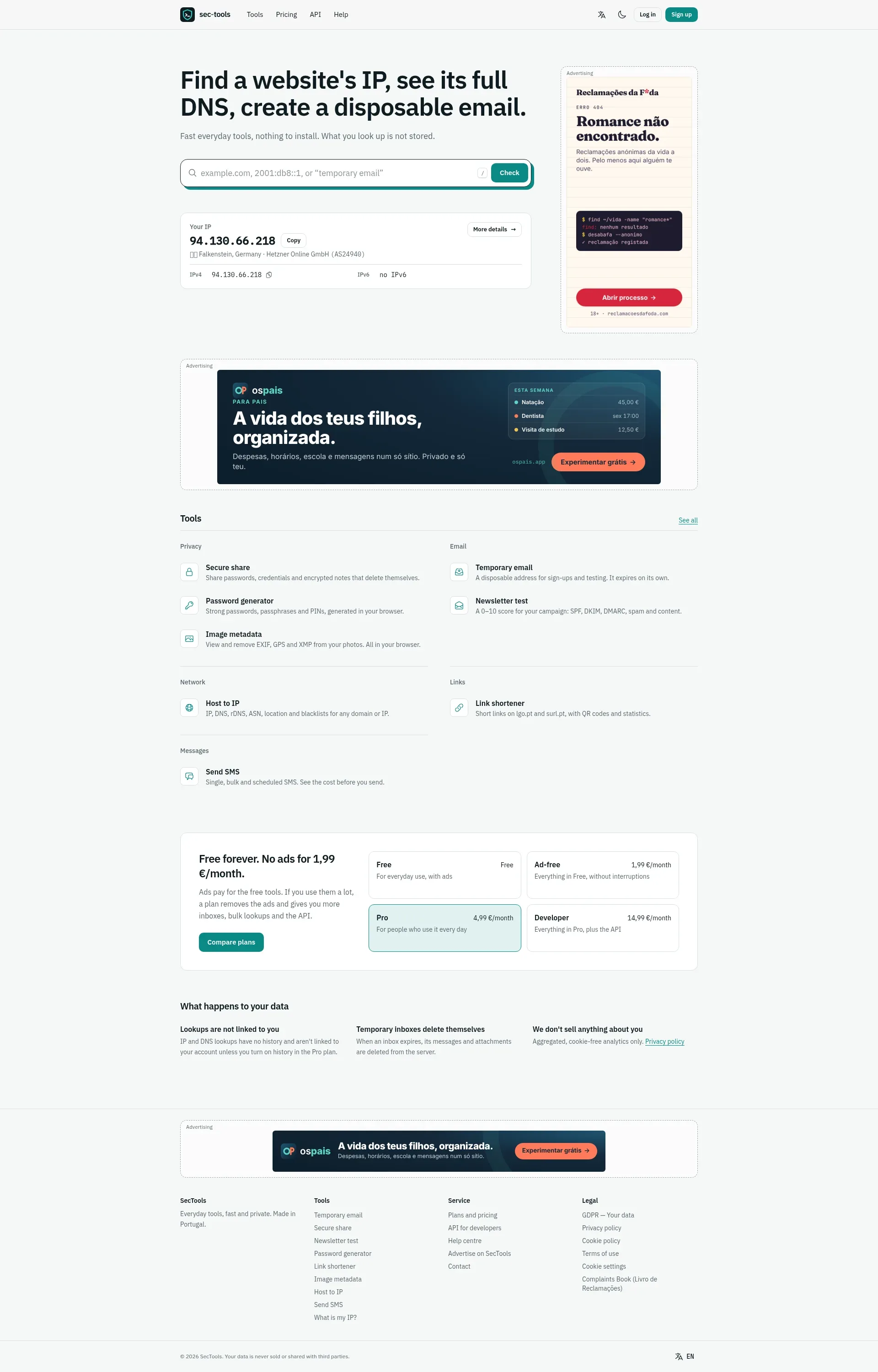
I created sec-tools.pt, a platform offering nine online tools for networking, email, security and privacy. It includes DNS lookups, temporary email, newsletter testing, secure sharing, password generation, SMS and image analysis, all designed to be simple and accessible.
DevelopmentMicroservicesPerformance OptimizationSystems Administration
 // client — Dotec →

// on this page (21)
Project: sec-tools.pt — Online Tools Platform
Development: Concept, design, full-stack development and infrastructure of an independent platform
Anyone who works regularly with the Internet, websites, servers or email services knows that some of the simplest tasks can end up taking more time than they should.
Checking a domain's IP address, verifying email configurations, generating a secure password or sharing confidential information are just a few examples.
The problem is that we often need to visit several different websites to complete these tasks. Each has its own interface, limitations and, sometimes, unclear practices regarding the information we provide.
That was the idea behind sec-tools.pt, a platform I created to bring several useful tools together in one place, without requiring software installation and with a strong focus on security and privacy.
The objective was straightforward: create a space where anyone could access practical, fast and easy-to-use tools, without unnecessary complications.
Because the Internet shouldn't be complicated, I wanted every tool to solve its particular problem as directly as possible.
The Challenge: Too Many Tools, Too Many Websites
Over the years, I've used countless online services to deal with small but recurring tasks.
One website to check domain information, another to verify email reputation, another to generate passwords and yet another to share documents securely.
Although these services are useful, the experience isn't always ideal.
Some display excessive advertising, others require unnecessary registrations, and not all of them clearly explain what happens to the information users submit.
Many existing solutions are also designed primarily for technical audiences, making relatively straightforward tasks more complicated than they need to be.
The idea for sec-tools.pt came from this exact need: bring useful tools together, make them more accessible and put user trust first.
I also wanted the platform to be available in Portuguese, with a clear presentation and a consistent experience across all its tools.
Nine Tools, One Platform
Rather than developing several independent websites, I created a platform where all the tools share the same identity and user experience.
sec-tools.pt brings together nine tools covering different needs related to networks, email, security, privacy and communication.
The platform was designed to provide direct access to its features, without forcing visitors to navigate complicated menus.
On the homepage, a smart search bar recognises whether someone has entered a domain name, an IP address or an email address, automatically directing them to the most appropriate tool.
It's a small detail that perfectly reflects the philosophy behind the project.
Fewer steps, fewer complications and faster results.
Domain and IP Address Information
One of the platform's main tools is Host2IP.
It allows users to enter a domain name or IP address and explore information about its configuration and presence on the Internet.
Users can check the addresses associated with a website, examine DNS records, identify network providers, obtain approximate geographical information and review different configuration details.
The tool also compares responses from services such as Cloudflare, Google and Quad9, helping users identify potential differences in domain resolution.
This information is particularly useful for website administrators, server managers and anyone interested in understanding how a domain is configured.
My aim was to bring several types of network analysis into one organised interface, making the results easier to access and understand.
What's My IP Address?
Another feature is the What's My IP tool.
Simply opening the page allows visitors to check their public IP address, including available IPv4 and IPv6 information, Internet service provider details and approximate geographical location.
The tool also helps users understand which Internet protocols their connection supports.
For those who only need to retrieve their IP address quickly, I also provided ways to obtain this information through simple command-line requests.
It's one of those seemingly small features that can be useful on a regular basis, both for IT professionals and everyday Internet users.
Temporary Email Without Using Your Personal Inbox
There are situations where we don't want to provide our personal email address just to create an account, test a service or receive a one-off message.
To address this, I developed a temporary email service using the domain 0mail.dev.
The tool allows users to create disposable inboxes, receive messages and view their contents for a limited period.
Once an inbox expires, it is no longer available.
This can be useful for testing, verification and situations where a permanent personal email address isn't necessary.
The objective is to provide a practical alternative for temporary communications, rather than replace traditional email services.
Test Newsletters Before Sending Them
Sending a newsletter is relatively easy. Making sure it reaches recipients' inboxes is another matter.
Several factors can affect email deliverability, from domain configuration and server reputation to the contents of the message itself.
That's why I developed a Newsletter Testing tool.
Users send an email to a dedicated testing address and receive an analysis of different factors that may affect delivery.
The platform checks email authentication settings, identifies potential reputation issues and examines message characteristics that may require attention.
The results are presented in an organised format, helping users understand what is configured correctly and what could be improved.
This feature is particularly useful for businesses, online shops and marketing professionals who rely on email communication.
The idea is to identify potential problems before sending a campaign to hundreds or thousands of contacts.
Sharing Confidential Information More Securely
We've all needed to share a password, document or piece of information that shouldn't remain permanently accessible in a conversation or email inbox.
I developed the Secure Sharing tool for exactly these situations.
It allows users to create links for sharing confidential information, with options such as password protection and automatic deletion.
One of its most important features is that information is encrypted directly on the user's device before being transmitted.
The key required to decrypt the content is not sent to the platform's server.
This means that, under the tool's intended operation, even the server itself cannot read the information being shared.
It's a way to provide greater privacy while reducing unnecessary exposure of sensitive information.
Strong Passwords Without the Complications
Creating a secure password remains one of the simplest and most important steps towards protecting online accounts.
However, many people still use passwords that are easy to guess or reuse the same credentials across multiple services.
sec-tools.pt includes a Password Generator that creates random passwords, passphrases and PIN codes.
The tool also provides an assessment of password strength and allows users to check for signs of exposure in known data breaches, without sending their complete password.
Password generation takes place directly in the browser, without transmitting the generated credentials to the server.
The aim is to make good security practices easier to adopt, even for people without technical knowledge.
Shorter Links, Better Sharing
Sharing extremely long web addresses isn't always convenient.
That's why I integrated a URL Shortener into sec-tools.pt, connected to the lgo.pt and surl.pt services.
The tool allows users to turn long URLs into shorter links that are easier to share.
Depending on the selected options, users can create custom addresses, generate QR codes, set expiration dates or add password protection.
Statistics are also available to help monitor link usage.
This feature can be useful for marketing campaigns, social media, printed materials or simply sharing links in a cleaner, more organised way.
Sending SMS Messages Made Simple
sec-tools.pt also includes an SMS Sending tool for users who need to send individual messages or communicate with multiple recipients.
Messages can be prepared for immediate delivery, sent in bulk or scheduled for a later date.
The service operates through a credit system, giving users control over their spending.
Before confirming a message, the platform displays the estimated cost.
This is particularly important because certain characters, including accented letters and emojis, can affect how many message segments are needed.
The objective is to make SMS communication straightforward while keeping pricing clear before each operation.
Discover What Your Images Reveal
A photograph can contain much more information than what we can actually see.
Depending on the device and how the image was created, it may include the date, camera model, technical settings and even geographical coordinates.
This information, known as metadata, can be useful, but it can also create privacy concerns when photographs are shared.
The Image Metadata tool allows users to inspect this information and remove data they don't want to disclose.
Processing takes place directly in the browser, so the image doesn't need to be uploaded to the server.
The tool also looks for certain indicators associated with AI-generated images.
These indicators are informative rather than definitive: they cannot, on their own, establish an image's origin with certainty.
The goal is to give users greater awareness and control over the information that may be hidden inside their photographs.
Privacy as a Principle, Not an Optional Feature
From the beginning, one of my main priorities was to develop a platform where privacy was more than just a marketing promise.
Tools handling sensitive information were designed to minimise the amount of data transmitted or stored.
For example, passwords are generated on the user's device, image metadata is analysed locally, and information shared through Secure Sharing is encrypted before reaching the server.
Services that require communication with the platform's servers follow their own data processing and retention rules.
I also implemented account protection measures, access controls and safeguards intended to reduce the risk of misuse.
Where particularly sensitive operations are involved, I aimed to keep unnecessary elements, such as advertising and certain third-party content, away from the user experience.
The principle is simple: each tool should only use the information it genuinely needs to perform its task.
Available in Four Languages
Although the project originally grew from needs I encountered in my own work, I wanted to create a platform that people in different countries could use.
sec-tools.pt is available in Portuguese, English, French and Spanish.
The translation goes beyond the text displayed on the pages.
Menus, tools, commercial information and even page addresses are adapted to the selected language.
This provides a more natural browsing experience and helps users discover the tools through search engines.
It also allows the platform to reach a broader international audience while maintaining a consistent identity across all four languages.
Free Tools and Options for Different Needs
An important decision was to create a model that could provide free tools while supporting the long-term operation of the platform.
sec-tools.pt combines free access with paid plans and additional services.
Users can choose a free plan supported by advertising or select paid options with an ad-free experience and higher usage limits.
There is also an option to purchase temporary ad-free access without committing to a long-term subscription.
For services such as SMS sending, I developed a prepaid credit system.
Costs are displayed before operations are confirmed, allowing users to remain in control of their spending.
The intention was to create a flexible platform suitable for both occasional visitors and people who use its tools regularly.
Payments Designed for Portuguese Users
I also wanted the payment experience to be simple and familiar, particularly for users in Portugal.
That's why I integrated payment methods such as MB WAY and Multibanco references, alongside card payments and PayPal.
The platform allows users to purchase plans, add credits and pay for other services through a centralised checkout process.
Payments are connected to an invoicing system, allowing the corresponding invoices to be issued automatically through Moloni.
This integration reduces administrative work and makes purchasing services more convenient.
Advertising Opportunities for Businesses
To help support the platform, I also developed a dedicated advertising management system.
Alongside directly managed campaigns, sec-tools.pt offers advertising opportunities for businesses interested in promoting their products or services.
Advertisers can select an advertising placement, choose the campaign duration, upload their creative material and complete payment.
Once reviewed and approved, the campaign can be published on the platform.
The process is supported by a management area, reducing the need for manual communication and administrative tasks.
This approach creates commercial opportunities without relying exclusively on external advertising networks.
For tools involving sensitive information, privacy protections remain a priority.
A Personal Area for Managing Everything
Although several tools can be accessed directly, sec-tools.pt also provides a dedicated area for registered users.
From there, users can manage their accounts, subscriptions, credits, payments and associated services.
Accounts can be protected with two-factor authentication, adding an extra layer of security.
The platform also includes a searchable help centre, with information explaining the available tools and answering common questions.
For users and businesses that need to connect certain features to their own systems, an API is available to support automated interactions.
This makes sec-tools.pt suitable for both occasional visitors and professionals with more specific requirements.
A Platform Built to Keep Growing
One of my goals from the very beginning was to ensure that sec-tools.pt wouldn't be limited to its initial set of tools.
I therefore designed the application to allow new features to be added without disrupting existing ones.
Each tool can be managed individually through the administration area.
This makes it possible to enable or disable services, adjust settings and introduce new functionality in a structured way.
The platform also provides management tools for users, payments, plans, advertising and website content.
This flexibility became particularly important as the project evolved rapidly, progressing through nine development releases, from version 1.0.0 to 3.2.0, between October and November 2026.
Rather than launching a fixed collection of tools, I wanted to create a foundation capable of supporting new ideas and future requirements.
Infrastructure Built and Managed In-House
Another distinctive aspect of sec-tools.pt is that I didn't just develop the application.
I was also responsible for designing, preparing and configuring the infrastructure needed to run it.
The platform operates on privately managed server infrastructure, with dedicated services supporting its tools, background tasks and temporary email reception.
This approach gave me more direct control over performance, security, availability and communication between the different services.
I also developed processes to simplify application updates and ongoing maintenance.
The aim was to create an organised, reliable environment capable of evolving alongside the platform.
For the end user, all this complexity should remain invisible.
What matters is opening a tool, using it and getting the expected result.
The Result: Useful Tools, a Simpler Experience
sec-tools.pt evolved from an idea into a platform featuring nine tools, four languages, several commercial options and a complete administration area.
Throughout development, I introduced new functionality, refined the user experience and strengthened the platform's security and privacy measures.
The project now covers everything from network lookups and email testing to communication services, secure sharing and image analysis.
Every feature was developed with the aim of providing a consistent experience, without forcing users to learn how to work with several unrelated services.
The result is a digital platform designed to grow and accommodate additional tools over time.
More Than Bringing Tools Together, Creating a Better Experience
sec-tools.pt reflects how I like to approach technology.
Sometimes, creating something valuable doesn't require inventing an entirely new concept.
It can simply mean identifying tasks we perform every day, understanding what could work better and building a simpler, more accessible solution.
For this project, the challenge was to bring different needs together within a coherent platform, without compromising security, privacy or ease of use.
From the initial concept and development of the tools to infrastructure, payments and the browsing experience, I designed and developed the entire project from scratch.
For me, what matters most isn't how many technologies were used, but what the final product allows people to accomplish.
Saving time, simplifying everyday tasks and giving people tools they can trust.
Because technology should work for us, not make us waste time on things that could be simple.
sec-tools.pt — Useful tools. Fewer complications. More privacy.