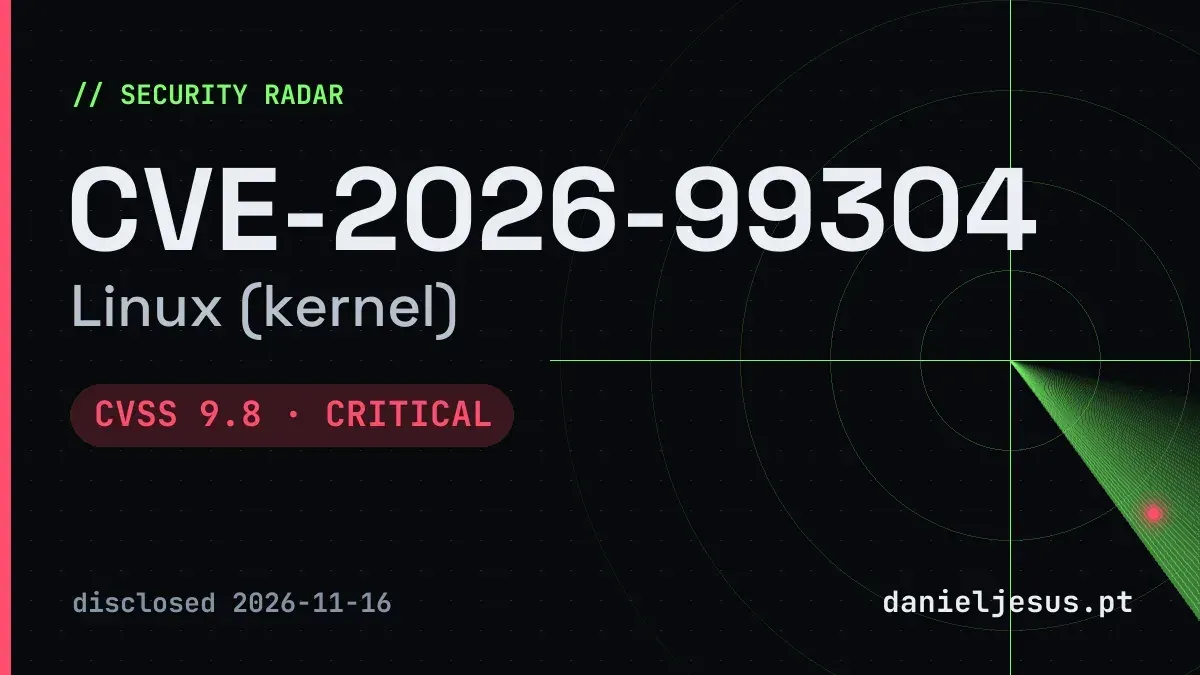
CVE-2026-99304: Critical Vulnerability in Linux Kernel
A critical vulnerability has been identified in the Linux kernel affecting Ceph functionality.
// on this page (8)
Introduction
A critical vulnerability has been identified in the Linux kernel, specifically related to Ceph. This flaw may allow an attacker to compromise the integrity and availability of the system, making it a significant concern for system administrators and store owners using this technology.
What happened?
The vulnerability lies in the ceph_update_snap_trace() function, which performs bounds checks on encoded snapid arrays. An error in the addition of counts from messages can lead to an integer overflow, allowing an attacker to send a malicious message that could compromise the system. The issue occurs when the sum of the snaps evaluates to zero, causing the security check to fail.
How does the vulnerability work?
The vulnerability results from an error in how snap counts are handled. When an MDS (Metadata Server) sends a number of snaps and a number of prior parent snaps, the sum can result in a value that causes an overflow, leading to out-of-bounds memory reads. This can be exploited by a malicious or compromised MDS, without any client-side action required.
What is the real impact?
The impact of this vulnerability is critical, as it may allow an attacker to compromise the integrity and availability of the system. Successful exploitation could result in data corruption or denial of service, directly affecting the operation of systems relying on Ceph for data storage and management.
Which versions are affected?
- Versions of the Linux kernel using Ceph functionality (specific details should be confirmed in the vendor advisory).
How to fix
- Check the version of the Linux kernel in use.
- Consult the vendor advisory for information on fixed versions.
- Update the kernel to the latest version that contains the fix for this vulnerability.
- Test the new version in a controlled environment before deploying it in production.
- Monitor systems after the update to ensure no additional issues arise.
Mitigation while you update
While it is not possible to apply the update, consider the following mitigation measures:
- Limit access to the MDS and other Ceph components only to trusted users and systems.
- Implement monitoring and alerts for suspicious activities on the system.
- Review system security configurations to minimize exposure to attacks.
Conclusion
The CVE-2026-99304 vulnerability poses a significant risk to systems using the Linux kernel with Ceph. It is crucial for system administrators to take immediate action to remediate the flaw and protect their data and operations.
// Fontes
- NVD — CVE-2026-99304 nvd.nist.gov ↗
- CVE.org — CVE-2026-99304 cve.org ↗
- Linux kernel (git) git.kernel.org ↗
- Linux kernel (git) git.kernel.org ↗
- Linux kernel (git) git.kernel.org ↗
- Linux kernel (git) git.kernel.org ↗