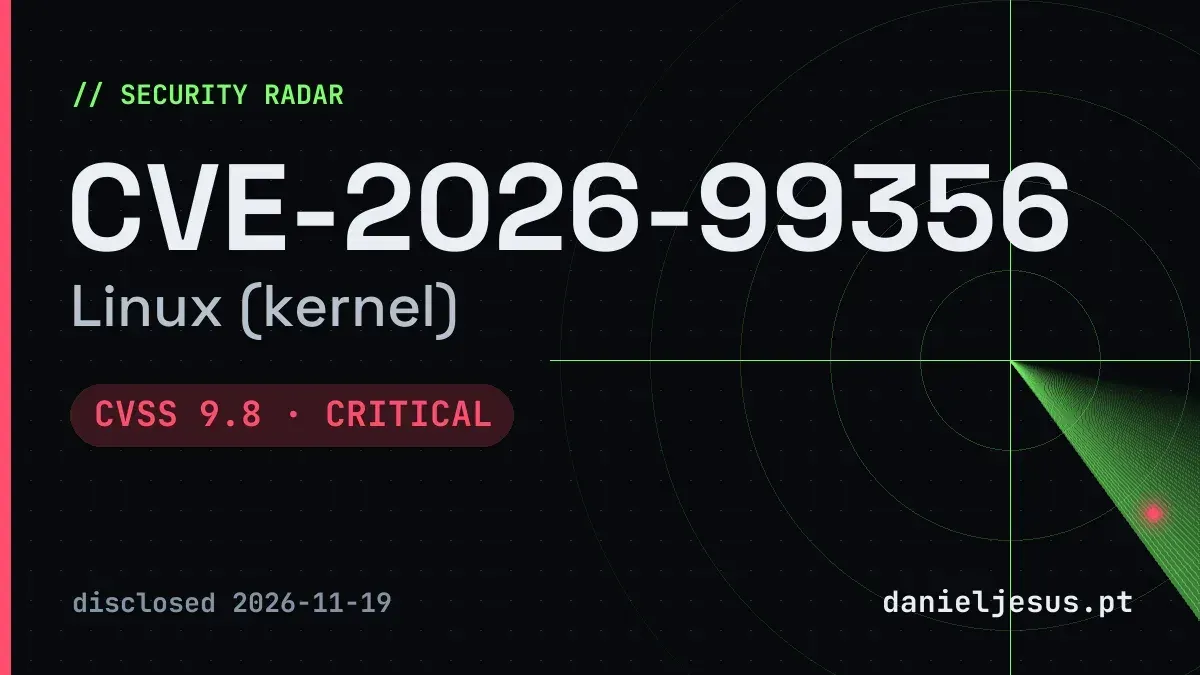
CVE-2026-99356: Critical Vulnerability in Linux Kernel
A critical vulnerability has been identified in the Linux kernel, affecting the integrity of RPC communication.
// on this page (8)
Introduction
A critical vulnerability has been identified in the Linux kernel that may affect the integrity of RPC communication. This vulnerability allows data to be credited to an RPC stream without being actually received, potentially compromising system security and stability.
What happened?
The vulnerability lies in the svc_tcp_sock_recv_cmsg() function, which receives up to two octets into a local buffer. Although this count is returned for record types other than TLS_RECORD_TYPE_ALERT, nothing is transferred to the caller's buffer. As a result, the RPC stream advances over octets that were never received, which can lead to incorrect data handling.
How does the vulnerability work?
The vulnerability allows a conforming client to send a KeyUpdate after it has sent its Finished. The svc_tcp_read_marker() and svc_tcp_read_msg() functions add counts to variables that do not reflect the reality of the data received, allowing potentially invalid data to be processed. This can result in serious security issues, including the potential for sensitive information leakage.
What is the real impact?
The impact of this vulnerability is classified as critical, as it can compromise the confidentiality, integrity, and availability of data. Systems that use the Linux kernel for network operations, especially those relying on RPC, are at risk. Exploiting this vulnerability could lead to severe consequences, including the execution of malicious code or service disruptions.
Which versions are affected?
- Versions of the Linux kernel unspecified.
Confirmation of the affected versions should be checked in the manufacturer's advisory.
How to fix
- Check for available updates for the Linux kernel.
- Upgrade the kernel to the latest available version that addresses the vulnerability.
- Test the new version in a controlled environment before deploying it in production.
- Monitor systems after the upgrade to ensure there are no compatibility issues.
Mitigation while you update
While it is not possible to apply the update, consider the following mitigation measures:
- Limit network access to services using RPC.
- Implement firewalls to restrict unnecessary traffic.
- Monitor system logs for suspicious activities.
Conclusion
The CVE-2026-99356 vulnerability in the Linux kernel poses a significant risk to system security. It is crucial for system administrators and store owners to check and update their implementations to protect against potential exploits.
// Fontes
- NVD — CVE-2026-99356 nvd.nist.gov ↗
- CVE.org — CVE-2026-99356 cve.org ↗
- Linux kernel (git) git.kernel.org ↗
- Linux kernel (git) git.kernel.org ↗
- Linux kernel (git) git.kernel.org ↗
- Linux kernel (git) git.kernel.org ↗